
Tema Oil Refinery (TOR) Managing Director Edmond Kombat disclosed that he has initiated direct conversations with government on mechanisms to recapitalise the company’s balance sheet – including releasing the refinery’s outstanding share of Energy Sector Levy Act (ESLA) receivables, which he says stand at a minimum GH¢1.6billion.
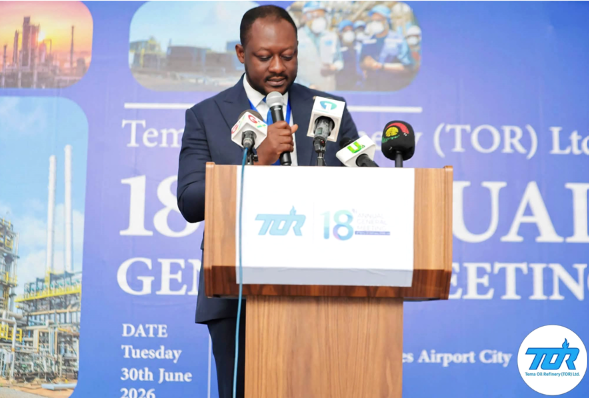
Presenting his review at TOR’s 18th annual general meeting, Mr. Kombat said addressing the company’s accumulated deficit of GH¢7.869billion and negative equity position of GH¢4.53billion will require sustained profitability, continued debt restructuring and dialogue with the state on how to strengthen the balance sheet.
“Addressing this will require sustained profitability, continued debt restructuring, and dialogue with the Shareholder about mechanisms available to recapitalise the company’s balance sheet – especially with releasing TOR’s portion of the ESLA receivable. I have initiated those conversations and I am determined to see them through,” he said.
Mr. Kombat’s disclosure reinforced an appeal made earlier in the meeting by Board Chairman Nayon Bilijo, who disclosed that approximately GH¢3.4billion has been collected for TOR through ESLA – of which GH¢1.47billion has already been applied to offset the company’s debt.
Mr. Bilijo said applying TOR’s remaining ESLA margin against its current debt exposure would represent a significant gain for the company’s debt portfolio.
“We strongly appeal that government through the Ministry of Finance helps restructure these debts by applying TOR’s margin in the ESLA receivables to settle them,” he said.
The appeal is set against a debt portfolio Mr. Bilijo said TOR inherited when the current board took office in July 2025: including US$97million owed to government, US$58million to Ghana National Petroleum Corporation (GNPC), US$78.9million to Volta River Authority (VRA), US$128million to Sahara Oil and US$41million to British Petroleum (BP).

“These debts, though inherited, continue to serve as stark reminders of past activities,” Mr. Bilijo said.
Mr. Kombat said TOR has made measurable progress in narrowing its debt position even as it awaits movement on the ESLA front. Total debt fell 13 percent in 2025 to GH¢2.33billion, while long-term borrowings declined 27 percent to GH¢695.5million – a reduction he described as a market vote of confidence.
“Lenders have reduced their exposure by 27 percent, which we regard as a vote of confidence in the company’s direction,” the MD noted.
Trade and other payables also fell, down 22.5 percent to GH¢5.52billion from GH¢7.12billion the previous year.
Even with that progress, Mr. Kombat was direct about the scale of what remains unresolved, stating: “The negative equity position reflects the accumulated losses of prior years and remains the most important financial challenge facing the Company over the medium-term”.
He added that the retained deficit had narrowed from GH¢8.96billion to GH¢7.87billion by year-end – evidence, he said, of balance sheet repair beginning to take hold.
Responding broadly to TOR’s debt concerns at the same meeting, Minister for Energy and Green Transition John Abdulai Jinapor said his ministry is engaging the Ministry of Finance on a comprehensive audit of balance sheets across state energy sector agencies, aimed at identifying and removing government-related debt that constrains their ability to raise commercial financing.
“What you want to do is to look at the debts, particularly arising from the government side, so that we can reduce it, take it off your balance sheet. A cleaner balance sheet would position companies such as TOR to go to the markets and raise finance at a time when borrowing costs have fallen considerably,” he said.
Mr. Kombat said the company’s recovery under his tenure has rested on restoring both operational and financial credibility. The Crude Distillation Unit (CDU) returned to sustained operation in 2025 following completion of its turnaround maintenance – processing approximately 600,000 barrels of crude oil in December alone, which he said is “tangible evidence that the asset is operational and capable of generating value when properly maintained and supplied”.
He noted that the Residue Fluid Catalytic Cracking (RFCC) unit, central to TOR’s profitability, remains under turnaround maintenance and is expected onstream by July 2026 – both projects executed largely by TOR’s own staff.
The company also cleared a six-year audit backlog dating back to 2019, delivering seven sets of audited financial statements to the State Interests and Governance Authority by May 2026, 2026, alongside a return to profitability – posting a post-tax profit of GH¢1.1billion after nine consecutive years of losses. Before taxes, the figure stood at GH¢1.42billion.
“We cleared six years of audit arrears. We recorded the first profit in a decade. We reduced debt, cut payables and improved collections,” he said.
“The company has consolidated its position and shown what is possible; recapitalisation of the balance sheet is now the central task ahead,” he added.
Post Views: 7
Discover more from The Business & Financial Times
Subscribe to get the latest posts sent to your email.