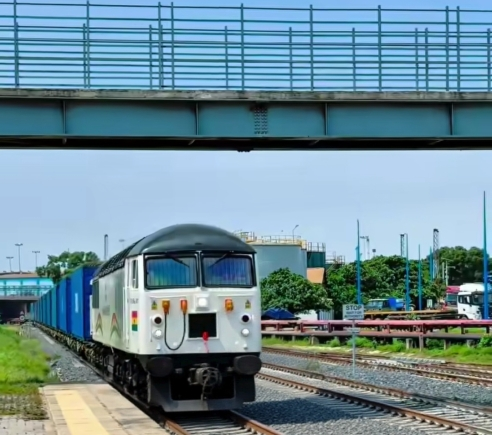
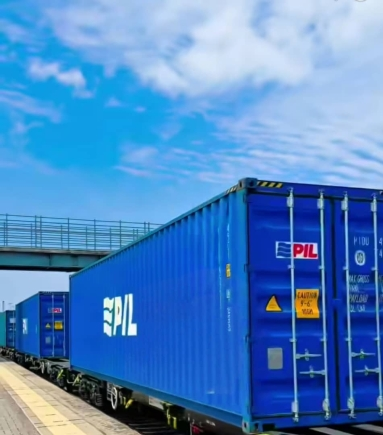
The Ministry of Transport has defended the government’s acquisition of two diesel locomotives and 20 freight wagons, dismissing concerns raised by critics as inaccurate and technically unfounded.
Videos of the newly acquired two diesel locomotives and freight wagons have been shared on social media amidst varied reactions with some concluding that they were old and outdated and not modern.
But in a statement issued on Thursday [July 2, 2026] by the Public Relations Unit of the Ministry of Transport, the ministry said the criticism of the British Rail Class 56 locomotives as outdated reflected a misunderstanding of railway engineering and operations.
It explained that the locomotives are not assessed solely by their age but by factors such as structural integrity, refurbishment quality, reliability, maintainability, route compatibility, spare parts availability and commercial performance.
The ministry said the two locomotives underwent extensive refurbishment in the United Kingdom before being imported into Ghana.
The work included complete overhauls of the diesel engines, traction motors, electrical traction equipment, bogies and braking systems, as well as the installation of modern railway communication and safety systems.
The Ministry explained that the locomotives were also tested and certified before export and are backed by a five-year warranty against operational defects.
Overhaul
The Ministry said that with routine maintenance, the locomotives were expected to remain operational for at least 15 years before requiring major overhauls.
Addressing concerns about maintenance and the availability of spare parts, the Ministry noted that the Class 56 locomotives remain in active commercial freight service in the United Kingdom and Hungary.
It added that the Ghana Railway Development Authority (GRDA) has secured commitments from suppliers to maintain a five-year stock of essential spare parts, while specialised engineers have already begun training Ghana Railway Development Authority (GRDA) technicians and engineers to build local maintenance capacity.
The Ministry also defended the cost of the acquisition, noting that the two freight locomotives and 20 container wagons were purchased for approximately US$3.18 million.
It contrasted this with the previous administration’s procurement of two PESA Diesel Multiple Unit passenger trains for about US$14.67 million.
According to the Ministry, comparisons between the two acquisitions were misleading because they serve different purposes.
“While the PESA trains were designed for passenger transport, the newly acquired Class 56 locomotives are intended for heavy freight operations and the establishment of Ghana’s first structured container rail freight business.” The Ministry said
Operations
It further rejected claims that the Tema-Mpakadan railway lacks cargo handling equipment.
It said GRDA already has two reach stackers and five heavy-duty forklift machines to load and offload containers, with plans underway to procure two gantry cranes to strengthen long-term terminal operations.
On the commercial viability of the project, the Ministry said freight demand along the Tema-Mpakadan corridor had been established through feasibility studies conducted before construction of the railway.
The Ministry disclosed that GRDA is finalising commercial off-take agreements, one of which was expected to generate approximately US$3.5 million in annual revenue.
The Ministry estimated that revenue from freight operations would enable the investment in the locomotives and wagons to be recovered within two years while providing many more years of productive service.
It also highlighted recent interventions by the current administration, including the restoration of passenger rail services between Kojokrom, Sekondi and Takoradi, the recommissioning of passenger trains, the revival of stalled railway projects and efforts to address inherited technical deficiencies on the Tema-Mpakadan line.
The Ministry maintained that the freight assets would reduce logistics costs, ease pressure on Ghana’s roads, support industrialisation and generate sustainable revenue, while advancing the government’s broader vision of positioning rail transport as a key pillar of the 24-hour economy.
Internodal transport
The Tema–Mpakadan Railway Project was designed to provide a safe, efficient, and reliable transport link for cargo operators and businesses serving northern Ghana.
A key component of the project is the development of a container terminal at Mpakadan in the Asuogyaman District.
The facility was aimed at integrating rail and lake transport, creating a seamless logistics corridor that connects the Tema Port to northern Ghana via the Volta Lake.
The corridor would also facilitate trade with the landlocked countries of Burkina Faso, Niger, and Mali, offering a faster and more cost-effective route for the movement of goods.
Beyond boosting regional trade, the project was expected to reduce heavy truck traffic on major highways, ease road congestion, and minimise axle load-related damage to the country’s road infrastructure.
DISCLAIMER: The Views, Comments, Opinions, Contributions and Statements made by Readers and Contributors on this platform do not necessarily represent the views or policy of Multimedia Group Limited.
DISCLAIMER: The Views, Comments, Opinions, Contributions and Statements made by Readers and Contributors on this platform do not necessarily represent the views or policy of Multimedia Group Limited.