
Violence broke out across France on Saturday during the latest day of demonstrations against hardship in schools and the cost of living.
At least 1,200 people were arrested during what the French government described as an “escalation in violence” alongside an estimated 550,000 taking to the streets.
In Paris, there were significant clashes into the evening with riot police, who used tear gas and water cannon on crowds.
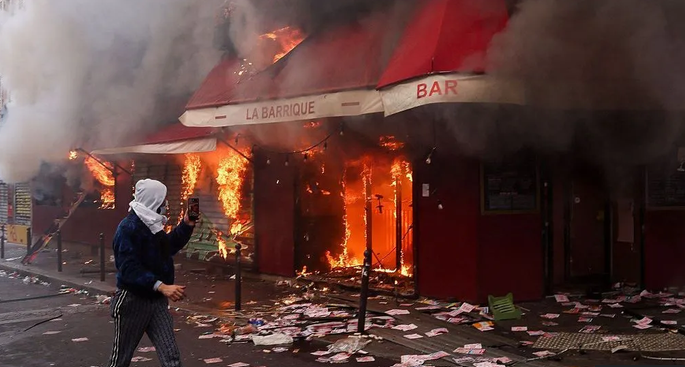
Buildings were set alight in the capital and other areas, including in Limoges where a large fire in the town hall caused the roof to partly collapse.
Looting broke out in several cities, with widespread vandalism targeting city halls and businesses also reported.
Prime Minister Sébastien Lecornu said 150 police officers were injured in the unrest.
In the French capital, the main march appeared to be largely peaceful during the afternoon. A group of young people told the BBC that they were “pacifists” who were “just trying to make things change, but nothing is moving”.
However, as the day wore on some groups lit fires in the street and torched vehicles, including in iconic locations in the city centre like the Place de la République.
Shops were ransacked, at least one restaurant was gutted by fire, and the BBC saw fighting breaking out among some of the groups.
Riot police were seen charging at one crowd in central Paris and hitting several people with batons.
In Lyon, Mayor Grégory Doucet said the burning of the city’s tourist office was “a tragedy”, telling BFMTV “it breaks our hearts because it’s a very iconic, well-known historic building”.
Local police said “hostile individuals” prevented firefighters from safely tackling the blaze.
Fire crews also battled the fire at Limoges town hall, which the local prefecture said caused part of the building to collapse.
A young man “had his hand blown off” by a small explosive in Saint-Étienne, the south-eastern city’s Mayor Régis Juanico said on social media, adding: “Such a tragedy should never have happened.”
While France is no stranger to outbreaks of protest and disorder, this round comes as the country heads into a period of deep political uncertainty.
French President Emmanuel Macron will leave office next year and polls suggest April’s presidential election could come down to a fight between the leader of the National Rally, Marine Le Pen, and Jean-Luc Mélenchon of the hard-left La France Insoumise party.
The latter took part in demonstrations in France and later accused police officers of “unleashing” on protesters, while condemning looting and arson.
Lecornu said his comments were “dangerous and cynical”.
He earlier said police had faced “violence of extreme intensity” and some groups were using the protests as a “warm-up” for the presidential elections, adding: “No-one will impose their political agenda through violence.”
Le Pen said “legitimate demands” voiced by protesters had been “held hostage by the far left”, accusing Mélenchon of fuelling the violence.

Macron said: “Those who have broken, attacked the prefectures as well as businesses, looted even our town halls, will be prosecuted and punished.”
The government has made apparent attempts at concessions, with Education Minister Édouard Geffray promising 3,000 extra supply teachers during a television interview on 8 October.
However, the protests have continued and intensified.
DISCLAIMER: The Views, Comments, Opinions, Contributions and Statements made by Readers and Contributors on this platform do not necessarily represent the views or policy of Multimedia Group Limited.
DISCLAIMER: The Views, Comments, Opinions, Contributions and Statements made by Readers and Contributors on this platform do not necessarily represent the views or policy of Multimedia Group Limited.
Source link