
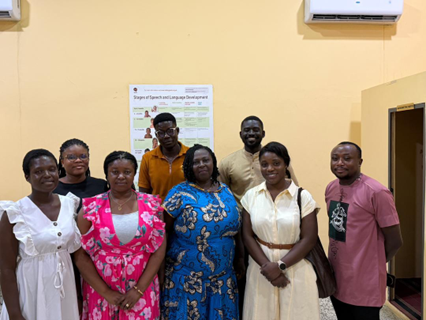

A significant number of Ghanaians living with hearing impairment received about 60 free hearing aids valued at approximately GH¢500,000.
The donation was made on Monday, 13 April 2026, through an initiative led by Dr. Julitta Amponsah, an Australian-based Ghanaian audiologist, in partnership with the University of Ghana’s Department of Audiology, Speech and Language Therapy and the Korle Bu Teaching Hospital.
The donation addresses a critical gap in hearing healthcare across Africa. According to the World Health Organisation, approximately 40 million people in the African region live with hearing loss — a figure projected to reach 54 million by 2030.
Yet only 10 percent of those who need hearing aids have access to them. In Ghana, where roughly 20 audiologists serve a population of over 35 million, the infrastructure challenge is acute.

Thus, the devices represent far more than amplification. They restore the ability to communicate, reconnect with loved ones, and participate fully in daily life. In Ghana, where the demand for hearing aids significantly outweighs availability, untreated hearing loss often leads to social isolation, reduced educational and economic opportunity, and diminished quality of life.
Among the beneficiaries is Samuel Kissi, a school teacher whose livelihood depends on clear communication.
“Before receiving the hearing aids, I struggled to hear my students clearly, especially in a noisy classroom.
“It affected how I taught and how confident I felt. I contemplated leaving the profession altogether. Now, I can hear their questions, their responses. This will completely change how I teach and how my students learn. It’s not just helping me, it’s helping every child in my classroom.” he shared.
For Dr. Amponsah, audiology is more than a profession, it is a personal mission.
“Hearing loss doesn’t just affect the ear, it affects relationships, confidence, education, and opportunity. I’ve seen how transformative the right intervention can be, and that’s what drives me to keep doing this work,” she said.
The University of Ghana’s audiology department played a central role in patient selection, fitting, and ongoing care.
“Access to hearing aids remains one of the biggest challenges for our patients. This donation allows us to immediately change lives while reinforcing the importance of ongoing audiological care,” said Mrs. Elsie Akosua Otuo-Acheampong.

Korle Bu Teaching Hospital supported patient identification and provided the clinical environment for assessments and fittings.
“Our role was to help identify suitable beneficiaries and provide a clinical environment for proper assessment and fitting. Partnerships like this are essential in expanding access to specialised services like audiology,” said Dr. Ewurama Ampadu Owusu.
Prof. Samuel Antwi-Baffour, Dean of the School of Biomedical and Allied Health Sciences, urged recipients to care for their devices. “By maintaining them properly and using them as advised, you are honouring the generosity of Dr. Amponsah — who funded these devices personally — while also giving yourself the best chance to fully benefit from improved hearing.
Dr. Amponsah views the donation as the first step in a longer-term commitment. A larger initiative is expected to launch next year, with plans for scaled hearing aid distribution, community outreach and screening programmes, and training and capacity-building for local audiology professionals, directly addressing the shortage of specialists that limits access to care.
“This is not a one-off gesture. It’s the start of something bigger; building a system where hearing care is accessible, sustainable, and continuous. If we can restore hearing, we restore lives,” Dr. Amponsah said.
Dr. Julitta Amponsah is the Founder and Clinical Director of DeciBelle Hearing, an independent audiology practice based in Australia. A Ghanaian-born audiologist, she is committed to expanding access to hearing healthcare in underserved communities, with a focus on making hearing care accessible, equitable, and life-changing.
The Hearing Healthcare Gap
According to the World Health Organisation, unaddressed hearing loss costs nearly US$1 trillion globally each year in healthcare costs, lost productivity, and societal impact. In Africa, the economic burden is estimated at US$27 billion annually. The WHO reports that an investment of less than US$1.40 per person annually could scale up ear and hearing care services globally, with a projected return of US$16 for every dollar invested over ten years.
Post Views: 46
Discover more from The Business & Financial Times
Subscribe to get the latest posts sent to your email.