

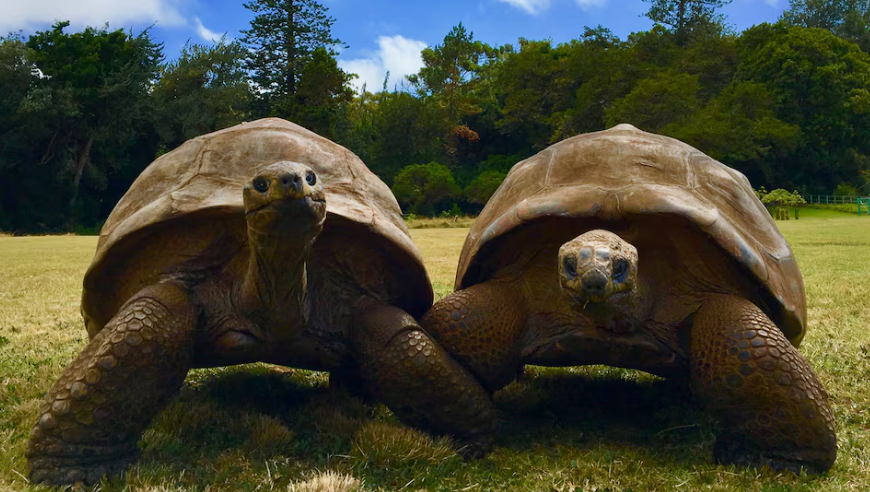
The world’s oldest-known terrestrial animal, an Aldabra giant tortoise named Jonathan and estimated to be about 194 years old, may owe his extraordinary longevity to a combination of genetic traits and an ability to keep key cellular systems functioning in a more youthful state, according to scientists.
Members of this species are known to live for more than 100 years, but Jonathan has far exceeded that. Brought to the remote South Atlantic island of St Helena as a fully grown animal in 1882, likely from Aldabra Atoll or the granitic Seychelles, the tortoise now lives in a paddock at Plantation House, the governor’s residence.
“Other Aldabra tortoises have been claimed to have lived as long as Jonathan, but he has the most documentary evidence supporting his age,” said Benjamin Vaisvil, a researcher affiliated with the organisation Kallel and co-lead author of the study, published on Wednesday in the journal Science Advances.
Scientists have studied Jonathan to investigate the secrets of his remarkable longevity by sequencing his genome and analysing his epigenome — the chemical markers that control which genes are switched on or off.
“We found changes in Jonathan’s genome in pathways associated with longevity, like DNA repair, mitochondrial function, insulin regulation and telomere function,” Vaisvil said.
Mitochondria are structures often described as the powerhouses of cells. Insulin is a hormone that helps regulate blood sugar by enabling glucose to enter the body’s cells for energy. Telomeres are protective caps at the ends of chromosomes, which carry genetic information inside cell nuclei.
Researchers compared Jonathan’s epigenome with those of four other Aldabra tortoises, ranging from juveniles to older adults. To collect a sample, they pretended to feed Jonathan and waited until he began biting the air. They then used a gloved hand to open his mouth and scraped beneath his tongue with a specialised kit. St Helena officials restrict blood draws to minimise the risk of infection.
To explain the findings, Vaisvil compared the genome to a cookbook and the epigenome to handwritten notes in its margins.
“As the cookbook ages, those notes become more difficult to read clearly. We can think of that as methylation entropy,” Vaisvil said, referring to a measure of disorder in a particular biochemical process.
Most of the notes in Jonathan’s “cookbook” appear very old. However, in certain regions of his DNA that act as switches controlling whether genes are turned on or off, his methylation entropy was lower than that of every tortoise studied except a five-year-old juvenile. These regions contained genes associated with longevity.
The researchers identified 287 genes with variants unique to Jonathan, including some linked to tumour suppression and DNA repair. The tortoise also carries extra copies of a gene that encodes a protein involved in identifying ageing and cancerous cells.
A “gentle giant”
When he was younger, Jonathan was known for mischievous antics, including overturning chairs and lying on croquet balls, according to his longtime veterinarian and study co-author, Joe Hollins.
Cataracts have since left him mostly blind, and Hollins now describes him as “a gentle giant”.
Determining how long giant tortoises can live is challenging because reliable historical records are scarce and many outlive the researchers studying them. Record-keeping before the 20th century was also less reliable. Although a young tortoise’s age can sometimes be estimated from growth rings on the plates that form its shell, determining the age of an adult is more difficult.
The new study involved only one exceptionally old tortoise, making it difficult to establish whether the traits identified are unique to Jonathan or common among long-lived tortoises.
“We cannot say for certain that what we found is the reason for his longevity,” Vaisvil said.
Environmental factors may also have contributed. Jonathan lives on a tropical island, where his diet is carefully managed by trained veterinarians.
The findings broadly align with patterns documented in studies of exceptionally long-lived people, suggesting that some mechanisms of ageing may be shared across species.
Vaisvil noted that a recent study of a 117-year-old woman found unusually efficient mitochondrial function, echoing findings in some regions of Jonathan’s genome.
A voracious appetite
Despite his age, Jonathan retains a voracious appetite, Hollins said. He lifts his head and stretches out his long neck when the veterinarian calls his name.
“I know he knows me, knows my voice and my handling, and I also know it isn’t love on his part but a recognition of the arrival of a feast,” Hollins said. “And yet I, of course, don’t mind. I have a huge affection for him.”
“He is a remarkable symbol. Icon, I know, is an overused word, but Guinness World Records has just given him ‘icon’ status this year,” Hollins said.
Beloved by residents of St Helena, Jonathan has lived through world wars and the rise and fall of empires.
“He is symbolic of resilience, longevity, endurance, a persistent presence throughout huge historic events,” Hollins said.
Source: Reuters