

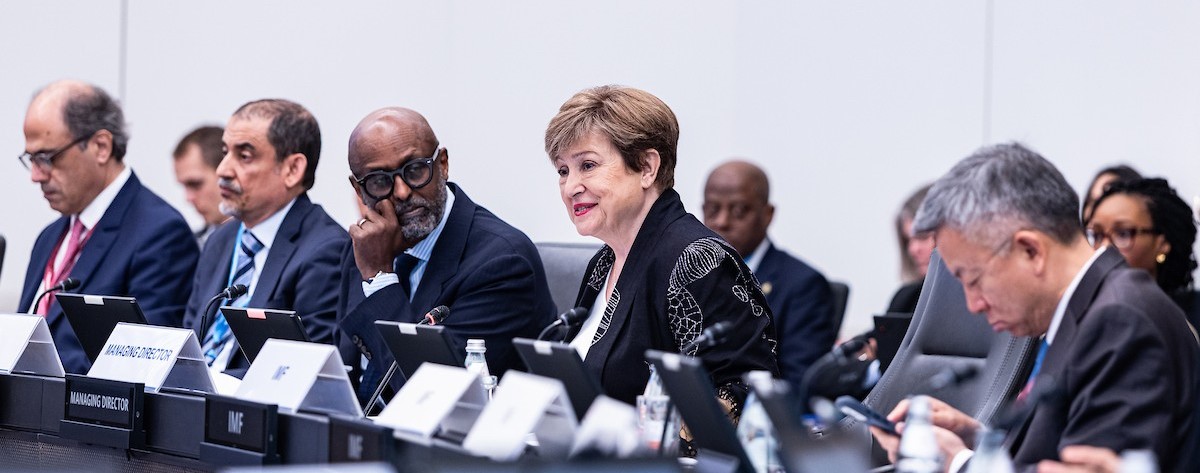
African Finance Ministers and Central Bank Governors have pushed for timely and robust debt sustainability assessments as conflict-related economic shocks intensify debt service pressures on low-income countries.
The African Consultative Group made the call at the end of a meeting with Ms Kristalina Georgieva, Managing Director of the International Monetary Fund (IMF), at the 2026 IMF/World Bank Group (WBG) Spring Meetings in Washington.
The Group said the ongoing review of the Low-Income Country Debt Sustainability Framework (LIC-DSF) was strengthening Fund–World Bank toolkit for assessing debt risks, calling for tailored advice and bolster shock management.
“This work is even more critical in the current environment, as war-related shocks are raising macroeconomic vulnerabilities and intensifying existing debt-service pressures, thereby underscoring the need for timely, transparent, and robust assessments of debt sustainability,” the Group said.
They encouraged the inclusion of a re-specified debt‑carrying capacity measure in the refinements to the methodology to improve transparency, comparability, and predictive accuracy.
They noted that improving debt sustainability assessments would help country authorities and partners to better identify vulnerabilities, calibrate policies, and support sustainable financing decisions.
The African Finance Ministers and Central Bank Governors said the process should also incorporate clarifying debt coverage and strengthening the treatment of State-Owned Enterprises-related obligations where relevant.
Data from IMF has showed that nearly 60 per cent of low‑income countries were already at high risk of debt distress or in distress, with debt ratios in sub‑Saharan Africa climbing sharply over the past decade.
Data by the World Economic Situation and Prospects 2025, published by the United Nations, has also disclosed that Africa’s public debt‑to‑Gross Domestic Product ratio reached 67.5 per cent, compared to less than 40 per cent a decade ago.
In that context, the Consultative Group underscored that solutions must go beyond diagnostics to include stronger collaboration between governments, multilateral institutions, and private creditors to ensure debt restructuring processes were timely, transparent, and fair.
The officials highlighted the importance of building resilience through domestic resource mobilisation, calling for expansion of tax bases, improving revenue collection, and curbing illicit financial flows to reduce reliance on external borrowing.
The Consultative Group reaffirmed that the LIC‑DSF review, combined with stronger transparency, creditor coordination, and domestic reforms, offered a pathway to restoring confidence and laying the foundations for sustainable growth across Africa.
The meeting recognised the work of the IMF and World Bank to integrate climate and social spending considerations into debt sustainability frameworks to ensure debt assessment account for the need to invest in resilience while safeguarding fiscal stability.
The IMF reiterated its commitment to providing technical assistance and policy advice, while the World Bank pledged to expand support for infrastructure and social investments that underpin long‑term debt sustainability.
Source: GNA