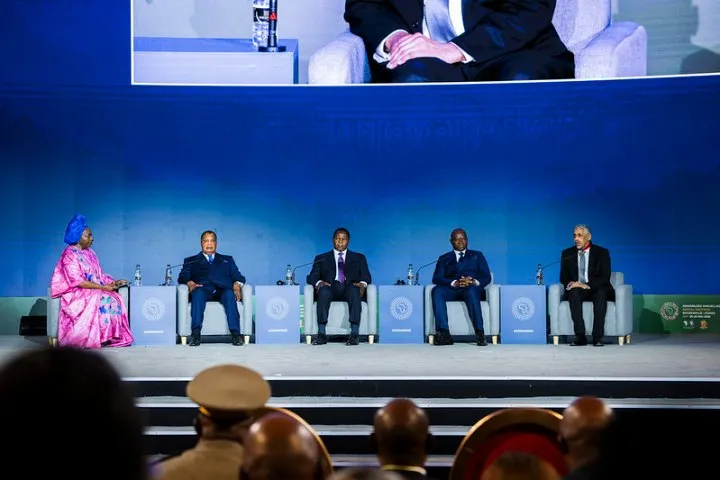
African leaders have called for greater investment in energy, infrastructure, industrialisation and climate finance while urging the continent to mobilise more private capital to accelerate economic development.
The calls were made during a presidential dialogue held Tuesday at the opening of the 2026 Annual Meetings of the African Development Bank Group in Brazzaville.
The high-level discussion featured President Brice Oligui Nguema of Gabon, President Faustin-Archange Touadéra of the Central African Republic, host President Denis Sassou Nguesso, and Dr Sidi Ould Tah.
Speaking before government officials, development partners, private sector leaders and civil society representatives at the Kintele Conference Centre, the leaders stressed that Africa must unlock new financing models and strengthen investment conditions to meet its development ambitions.
President Nguema said Gabon was working to transform its vast natural resources and biodiversity into long-term economic growth through eco-tourism and carbon-credit financing.
He revealed that the country had established a specialised agency to manage and market environmental credits internationally as part of efforts to monetise forest conservation initiatives.
“We would like to develop our forests while preserving nature,” President Nguema said. “By doing so, we can create ecological tourism without destroying our natural heritage.”
He also called for stronger international compensation mechanisms for countries within the Congo Basin that continue to protect critical global forest ecosystems.
President Sassou Nguesso emphasized the importance of diversifying African economies beyond oil and gas, despite hydrocarbons remaining central to national revenues in many countries.
The Congolese leader pointed to plans to expand fertiliser production using the country’s reserves of potash, phosphate and natural gas, positioning the Republic of the Congo as a future supplier to regional and international agricultural markets.
He also highlighted the importance of energy infrastructure in driving industrialisation across the continent, citing the hydropower potential of the Congo River basin and ongoing regional electricity projects supported by the African Development Bank Group.
“It is not possible to achieve development without energy,” he stated.
President Touadéra called for stronger support for landlocked African economies through investments in roads, electricity generation and regional connectivity projects.
“We have huge potential,” he said. “Today we have peace, and there are several sectors that can attract investors.”

He also expressed support for Mission 300, the joint initiative by the African Development Bank Group and the World Bank Group aimed at providing electricity access to 300 million Africans by 2030.
Addressing Africa’s financing gap, Dr Ould Tah said the continent possessed substantial untapped financial resources that could be mobilised to support bankable development projects.
According to him, nearly $4 trillion in African-held financial assets could be leveraged if governments and financial institutions work together to improve project preparation and investor confidence.
“It is our role at the bank to work with states and financial institutions to design bankable projects and mobilise the necessary financing,” he said.
Dr Ould Tah added that creating stronger investment protections and mutually beneficial partnerships would help attract more foreign direct investment into African economies.
“We need to create conditions for our partners to make gains also,” he noted. “This will help us crowd in more foreign direct investment.”
The presidential dialogue also repeatedly highlighted Africa’s youthful population as the continent’s most valuable development asset.
“Africa’s greatest asset is not our mineral resources; it’s our youth, our human capital. We must invest in them — in education, engineering and technical training. We must believe in them,” President Nguema said to applause from the audience.