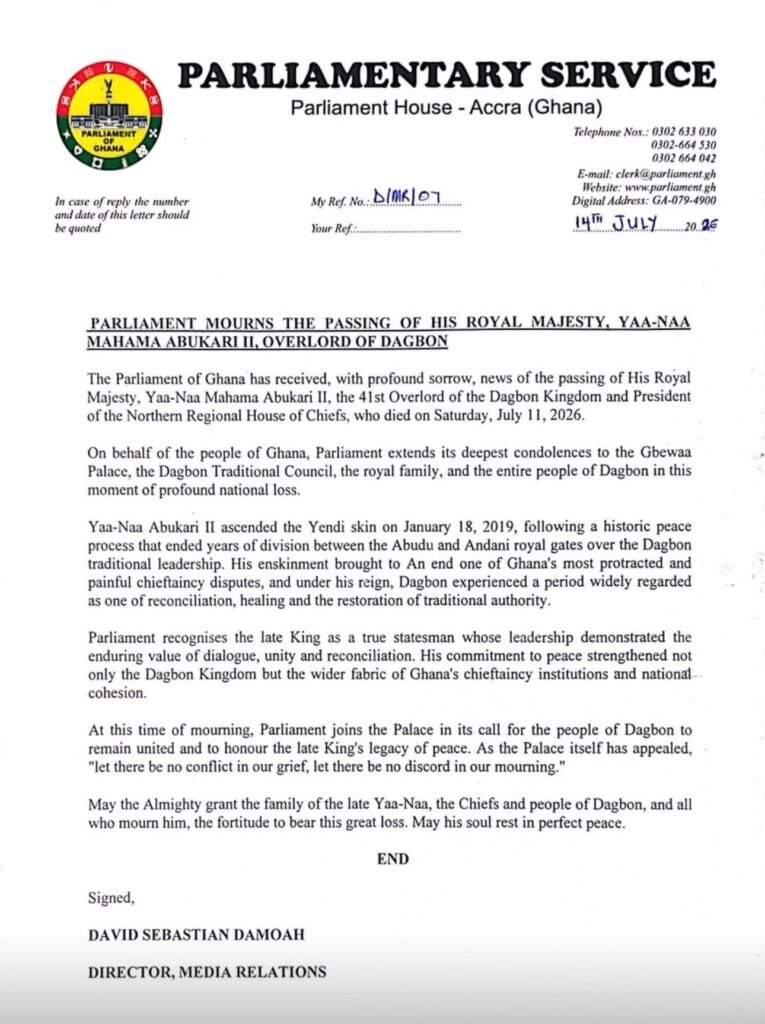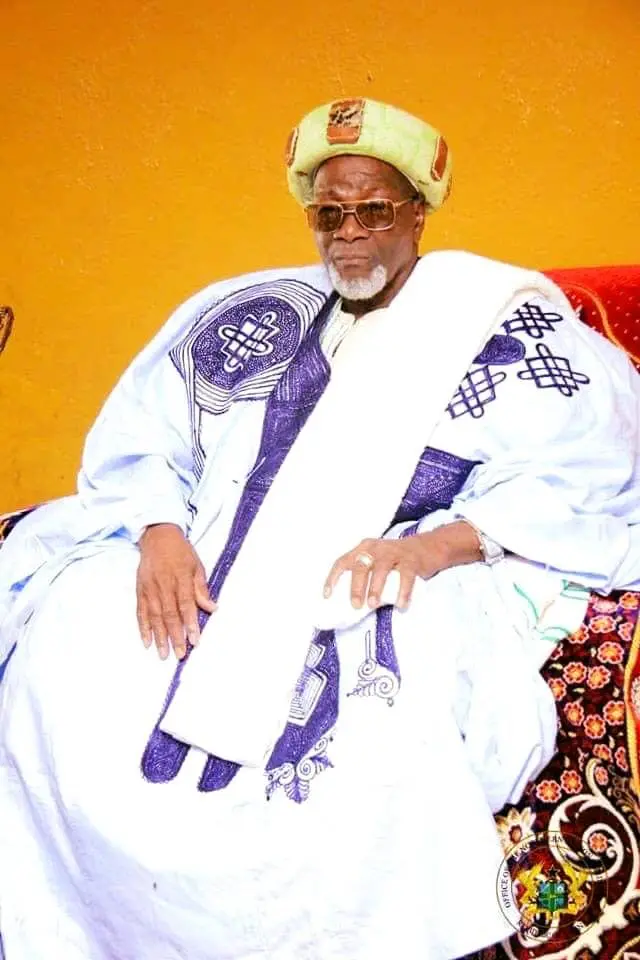
The Parliament of Ghana has expressed deep sorrow over the death of the Overlord of Dagbon, His Royal Majesty Yaa-Naa Mahama Abukari II, describing him as a statesman whose reign promoted peace, unity and reconciliation.
Yaa-Naa Mahama Abukari II, the 41st King of Dagbon and President of the Northern Regional House of Chiefs, died on Saturday, July 11, 2026.
In a statement issued on Tuesday, July 14, Parliament extended its condolences to the Gbewaa Palace, the Dagbon Traditional Council, the royal family and the people of Dagbon following the loss of the revered traditional ruler.
Parliament highlighted the late Yaa-Naa’s role in restoring stability to Dagbon after decades of tension surrounding the Dagbon chieftaincy dispute.
The statement noted that the late King ascended the Yendi skin on January 18, 2019, after a historic peace process that brought an end to years of division between the Abudu and Andani royal gates over the Dagbon throne.
“His enskinment brought to an end one of Ghana’s most protracted and painful chieftaincy disputes,” Parliament said, adding that his reign ushered in a period of reconciliation, healing and restoration of traditional authority.
The Legislature described Yaa-Naa Mahama Abukari II as a leader whose commitment to dialogue and unity strengthened not only Dagbon but also Ghana’s traditional institutions and national cohesion.
“Parliament recognises the late King as a true statesman whose leadership demonstrated the enduring value of dialogue, unity and reconciliation,” the statement said.
It further called on the people of Dagbon to remain united and uphold the late King’s legacy of peace as they mourn his passing.
“As the Palace itself has appealed, ‘let there be no conflict in our grief, let there be no discord in our mourning,’” Parliament added.
Yaa-Naa Mahama Abukari II was enskinned as Yaa-Naa in 2019 after the work of the Committee of Eminent Chiefs, chaired by the Asantehene, Otumfuo Osei Tutu II, helped broker a roadmap towards resolving the long-standing Dagbon conflict.
His reign was widely associated with efforts to consolidate peace, promote development and restore the traditional authority of the Dagbon Kingdom.
Parliament prayed for strength for the late King’s family, chiefs and people of Dagbon, and all those mourning his death.