
…calls for move from slogans to production
By Ernest Bako WUBONTO
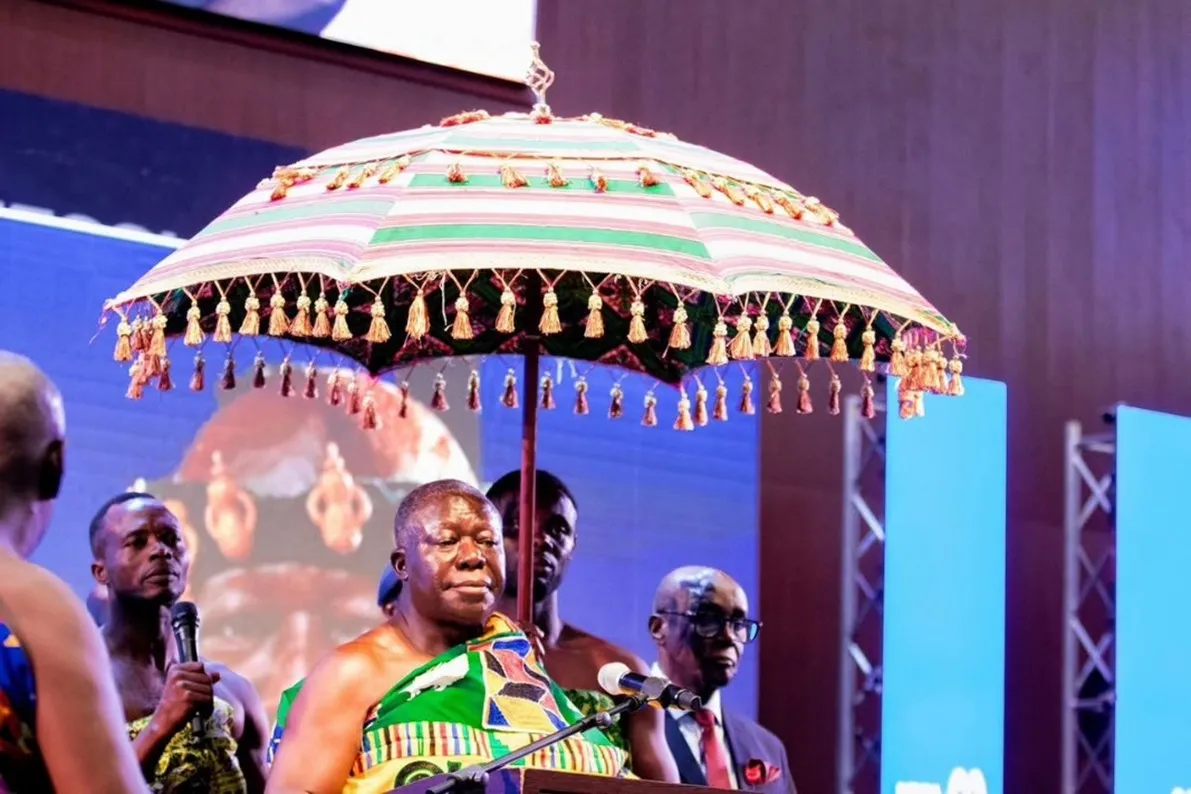
The Asantehene, Otumfuo Osei Tutu II, has made a clarion call for the dedication of the next 10 years entirely to building businesses, creating value and constructing a resilient economy, stating that after nearly 70 years of independence, the country must abandon political rhetoric.
He urged the government machinery, as the visionaries of the nation’s economic trajectory, to theme the next 10 years as a ‘decade of business development’, and create the enabling environment, policy initiatives and incentives that will foster the attainment of such a vision not a mere slogan.
Addressing the Ghana Business Leaders’ Conclave organised by the University of Professional Studies, Accra (UPSA), the monarch delivered an uncompromising economic manifesto, arguing that allegiance to the state must now override partisan loyalty if the nation is to escape decades of underperformance.
“After almost 70 years, the lesson is clear: we have had enough of talks, Ghana must now become a nation of builders. We must move from political rhetoric to building businesses, from slogans to production, from lamentation to enterprise, from dependency to value creation. We must move to sacrifice, passion and innovation,” he said.

Otumfuo’s call is a direct challenge to both the state and the private sector to treat the next decade as a compact for growth with the same urgency as a national security agenda. For the next decade, he demands political leadership to create enabling policy frameworks, ensure macroeconomic stability, and maintain the right regulatory environment, whilst citizens and entrepreneurs innovate, build enterprises, generate employment and drive the local value-addition of natural resources.
Asantehene insisted there is no truer measure of a nation’s development than the state of its economy, emphasisng that the ability to put food on the table, educate children, deliver healthcare and provide social amenities rests entirely on economic output. This, he linked to a reality that has been consistently betrayed by the post-independence habit of placing party before country.
Enabling environment
Touching on the theme for the conclave, ‘Leading with integrity, negotiation, mediation and ethical governance for business sustainability’, Otumfuo Osei Tutu II stressed that political leadership must continue to provide the enabling environment, policy frameworks, regulatory stability and security, but the real heavy lifting must now be done by citizens, entrepreneurs, professionals and institutions alike.
“The duty to create, innovate and build enterprises, create jobs and add value to natural resources falls on all of us. In today’s world, business is the driver of prosperity, irrespective of the nation. Enterprise, innovation, technology, creativity and bold leadership are all it takes,” he added.
Trust as a valuable asset
Trust, he said, remains the irreplaceable substratum of commerce, stressing that long before technology and legal language, trust, expressed in the traditional cycles as “my word is my bond,” was the foundation of business. He was concerned that Ghana is currently at a point where the erosion of trust and confidence now reaches from politics into banking, boardrooms, classrooms and homes.
Otumfuo warned that democracy may change governments through the ballot box, but only trust sustains society.
“Business has always been built on trust, long before technology, laws, contracts and legal language, the foundation of business was built on a simple principle: my word is my bond,” he reminded.
He prescribed six values as non-negotiable for the business leader in a fractured world: honesty, trust, fairness, respect, responsibility and courage. These are not foreign values, he noted, but universals deeply embedded in local customs.
The event, organised by UPSA, was in partnership with GCB Bank PLC and drew a cross-section of political, academic and corporate leaders.

Board Chairman of GCB Bank, Prof. Joshua Alabi, commended the Asantehene’s sustained commitment to youth development and peace building over the years, describing him as a true leader and a national resource to be cherished.
With 184 branches and a balance sheet that has served Ghana for over 70 years, GCB remains the only bank with a truly national footprint, actively supporting SMEs, public institutions and large enterprises through a sharpened digital transformation agenda, he highlighted.
“Institutions grow and nations prosper when knowledge, leadership and enterprise are brought together, and so, the GCB Bank is glad to support such an initiative and will continue to support the same in the future,” Alabi said.
He added that GCB Bank will continue to back initiatives that promote ideas, enterprise and meaningful contribution to Ghana’s development, insisting that education must deliver transformation, not merely certification. The task is no longer to lament the structure of the economy but to organise capital, talent and integrity around a decade of disciplined building.
Post Views: 1
Discover more from The Business & Financial Times
Subscribe to get the latest posts sent to your email.