


…to position Ada as West Africa’s salt export hub, boost forex earnings
By Christabel DANSO ABEAM ([email protected])
ElectroChem Ghana Limited is seeking to mobilise up to US$500 million to accelerate the development of its Ada Songor salt concession. This move is aimed at expanding production capacity, constructing a refinery and establishing a port to support large-scale exports.
The company believes the investment will enable it to transition from raw salt production into value-added processing, creating a stronger export industry capable of generating substantial foreign exchange earnings and strengthening Ghana’s role in the West African salt market.
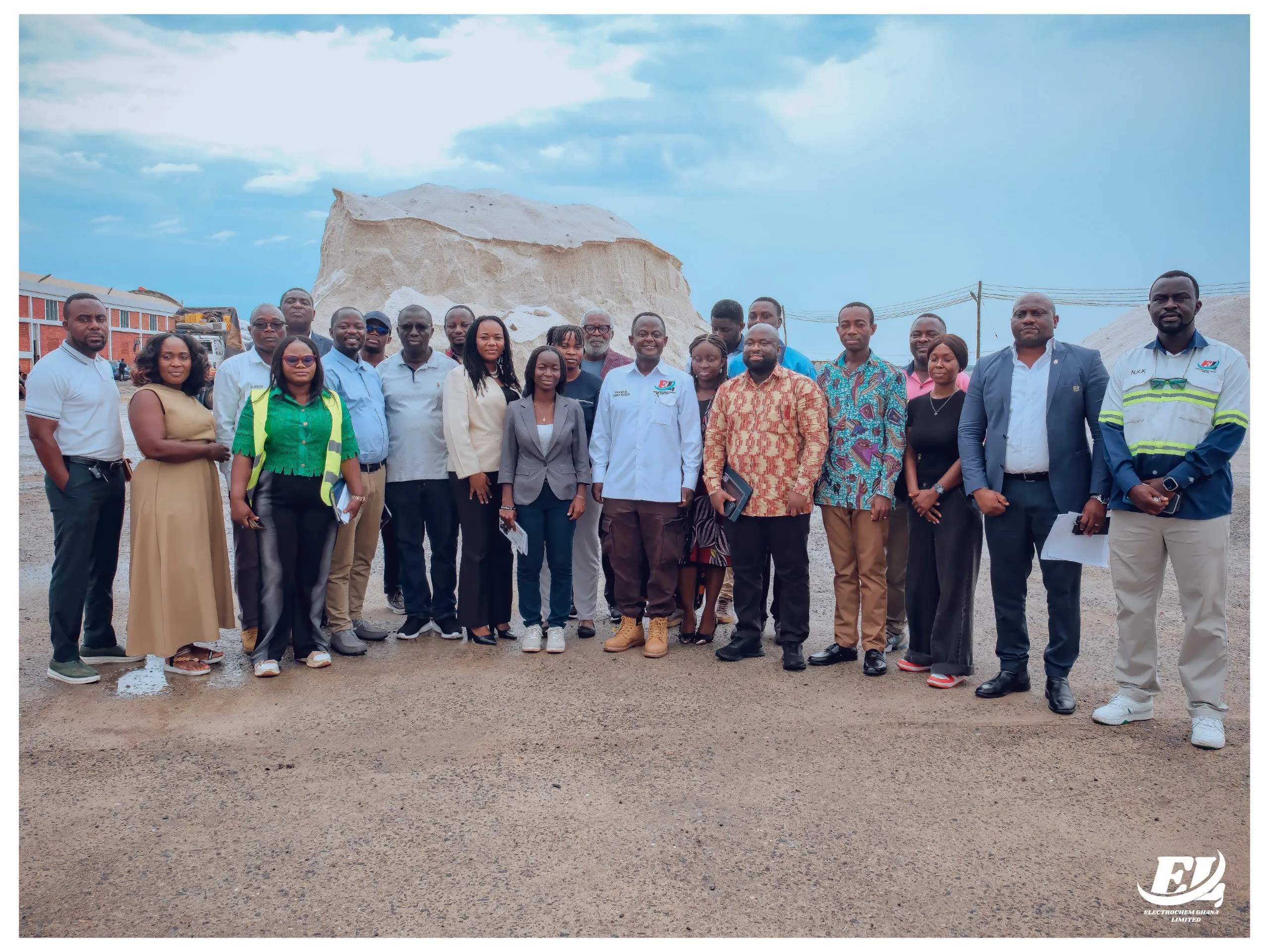
The company’s Chief Executive Officer (CEO), Francis Buamah, disclosed this in an interview with the media after a stakeholder engagement involving Civil Society Organisations (CSOs), the Ada Traditional Council and the media at the firm’s operations in Ada.
He explained that the visit was intended to provide greater transparency on the company’s activities, investments and future development plans.
“Today’s engagement was to invite CSOs, the Ada Traditional Council and the media to ElectroChem Ghana Limited to conduct fact-finding on our operations and achievements over the years. The purpose was also to promote transparency regarding the salt concession, the development work undertaken so far, and the investments required to further develop the salt industry, not only for our company but also for Ghana as a whole,” he noted.

Developing the salt value chain
According to Mr. Buamah, ElectroChem’s vision extends beyond the production of raw salt to building a fully integrated salt industry that captures more value within the economy.
The CEO explained that the company is currently targeting an initial US$60 million to expand its operations in Sector A of the concession and the construction of a refinery – while the broader US$500 million investment requirement would support the simultaneous development of the remaining sectors of its 41,000-acre concession as well as key supporting infrastructure.
The proposed investment will fund the expansion of production facilities, the construction of additional salt pans, roads and dikes, and the development of a dedicated port to facilitate exports.
“When people ask about the half-billion-dollar investment requirement, it is primarily for expanding development across our concession. We currently hold a 41,000-acre concession and are operating in Sector A. Sectors B and C, which stretch from Ada West to Ada East, still need to be developed.
From a sustainability perspective, transporting salt by road would place significant pressure on Ghana’s economy and road infrastructure. Therefore, we are looking to build a port. Given the millions of metric tonnes of salt, we aim to produce, sea transportation is the most economical and sustainable option,” Mr. Buamah clarified.
Value addition
Mr. Botwe further noted that refining salt locally could increase its value several-fold compared to exporting it in its raw form, helping to retain more value within the economy and increase export revenues.
“The value of raw salt is relatively low, ranging between US$25 and US$40 per tonne. However, once refined, its value can increase by as much as five times, reaching between US$200 and US$500 per tonne. It is important that Ghana moves beyond the traditional model of exporting raw materials. We want to add value locally and generate more foreign exchange earnings for the country,” he highlighted.

Investor interest growing
The CEO also disclosed that ElectroChem has already attracted interest from several international investors, including groups from Austria, the United Kingdom, France and the United Arab Emirates.
According to him, discussions are ongoing with potential investors, who are undertaking due diligence on the concession, production potential and the broader investment environment.
He said that though the company is seeking long-term investment partners capable of supporting its growth ambitions, it remains committed to working with partners whose interests align with its objective of maintaining strong Ghanaian participation in the business.
Mr. Botwe expressed confidence that the increasing demand for salt across industries such as pharmaceuticals, manufacturing, construction and food processing, coupled with the scale of the concession, makes the project an attractive investment opportunity.
Community development and employment
Beyond its commercial objectives, ElectroChem says the project is designed to deliver long-term socio-economic benefits to surrounding communities.
Mr. Botwe disclosed that about 90 percent of ElectroChem’s workforce is recruited from Ada, and continue to invest in skills development, educational support, apprenticeships and entrepreneurship programmes.
The company indicated that it is also supporting small-scale salt producers through a tributary arrangement under which their output can be purchased to supply future refining operations.
Looking ahead, the CEO said lessons have been learned from the development of Sector and have positioned the company to fast-track work on the remaining phases.
Kodzo Yaotse, Policy Lead, Petroleum and Conventional Energy – African Centre for Energy Policy (ACEP), in an interview after the engagement, underscored the need to broaden discussions on salt mining in Ghana and explore ways to maximise the potential of the resource.
“Salt is an important resource that we often seem to overlook, yet it remains relevant to our development priorities as a country. We need to begin looking at how we can strategically optimise this resource and create a framework that supports its sustainable development,” he said.
He stressed that Ghana’s industrial minerals sector, including salt mining, has not received adequate policy attention, and urged that a comprehensive policy framework was needed to guide the development of the industry.
To address investment challenges, Mr. Yaotse suggested that a possible listing on the Ghana Stock Exchange could provide an avenue for raising capital and expanding ownership of the company.
“With the performance of the Ghana Stock Exchange in recent times, listing could be one strategy to attract investment and allow more people, including communities, to participate in the ownership and growth of the business,” he said.
The Ada Traditional Council
On community involvement, a representative of the Ada Traditional Council during the engagement mentioned that the Council had prepared a position paper outlining its expectations and vision for the future management of the Songor salt resource.
He said the document, developed through consultations with chiefs, elders, youth groups and communities, provides a roadmap for addressing longstanding concerns and ensuring the sustainable development of the area.
He stressed that the Council’s priority is to ensure that local communities benefit from salt mining through job creation, economic opportunities and inclusive participation, while also allowing investors and businesses to operate.
He added that the Council acknowledges ElectroChem’s commitment to supporting community development and creating opportunities for the people within its operational area.
“We are not against development. We want to see jobs created and opportunities opened for our people,” he said, adding that collaboration among all stakeholders remains key to the future of the resource.
Post Views: 22
Discover more from The Business & Financial Times
Subscribe to get the latest posts sent to your email.