
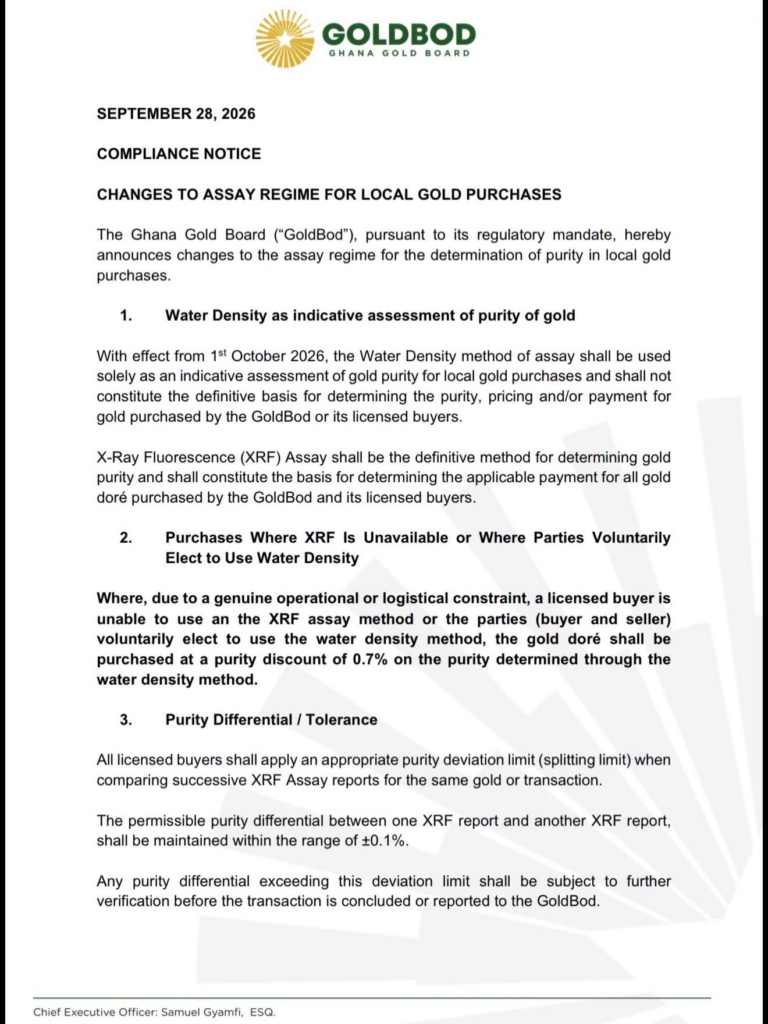
The Ghana Gold Board (GoldBod) has announced changes to the assay regime governing local gold purchases, with the new requirements taking effect from October 1.
In a compliance notice dated September 28, GoldBod said the changes are intended to clarify the methods used to determine the purity of gold purchased locally and the basis on which payments are made to sellers.
Under the new regime, water-density testing will no longer serve as the definitive basis for determining gold purity, pricing or payment.
Instead, X-Ray Fluorescence (XRF) assay will become the definitive method for determining the purity of gold purchased by GoldBod and its licensed buyers.
GoldBod said the water-density method will be retained only as an indicative assessment of purity. This means results obtained through water-density testing will not, on their own, determine the final price or payment for gold.
The move places XRF results at the centre of the purchasing process, making them the principal technical reference for establishing the purity of gold and calculating the applicable payment.
GoldBod has, however, provided for circumstances in which water-density testing may still be used.
Where a licensed buyer faces a genuine operational or logistical constraint that prevents the use of XRF, or where both the buyer and seller voluntarily agree to use the water-density method, the gold may be purchased based on the water-density result.
In such cases, GoldBod has directed that the gold dore be purchased at a 0.7% discount on the purity determined through the water-density method.
The provision therefore distinguishes between XRF-based transactions, which will provide the definitive purity basis, and transactions relying on water-density testing, where the prescribed discount will apply.
The new notice also introduces a specific tolerance for differences between successive XRF assay results relating to the same gold or transaction.
GoldBod said all licensed buyers must apply an appropriate purity deviation or “splitting” limit when comparing successive XRF assay reports.
The permissible difference between one XRF report and another must remain within ±0.1%.
Where the difference exceeds that limit, the transaction cannot simply proceed on the basis of the differing results. GoldBod requires the matter to undergo further verification before the transaction is concluded or reported to the Board.
The requirement is intended to provide a defined benchmark for resolving discrepancies between successive XRF assessments.
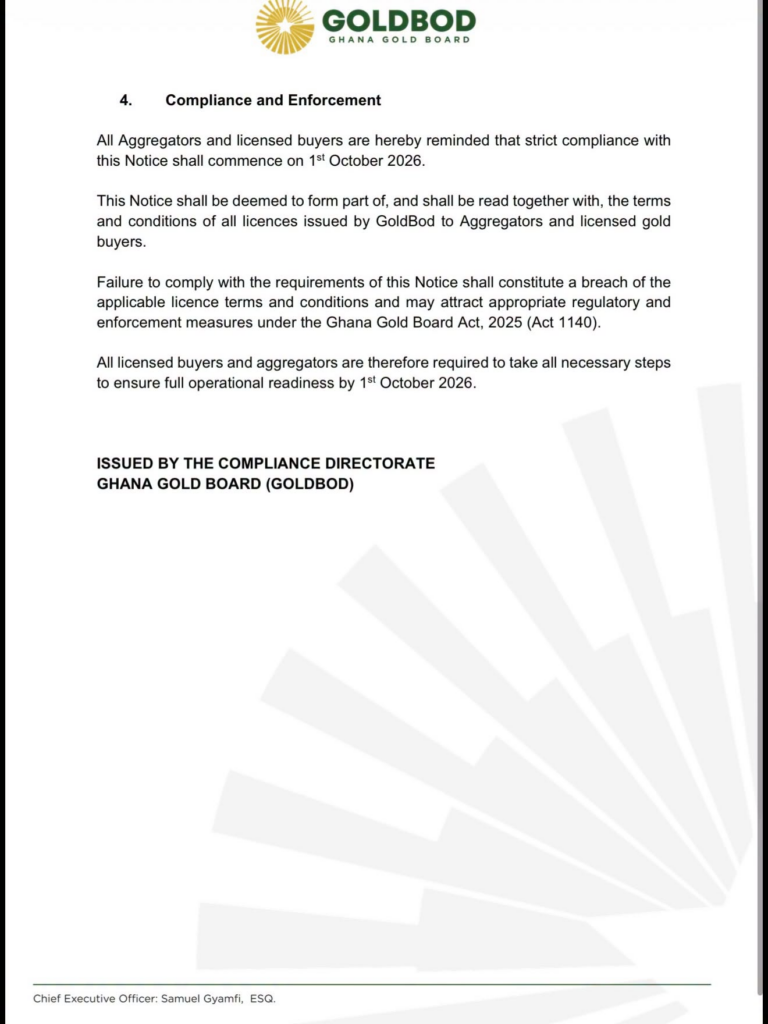
GoldBod said strict compliance with the notice will commence on October 1.
The requirements will apply to all aggregators and licensed gold buyers, and the notice will form part of, and be read together with, the terms and conditions attached to licences issued by GoldBod to aggregators and licensed gold buyers.
Failure to comply will constitute a breach of the applicable licence conditions and may result in regulatory and enforcement measures under the Ghana Gold Board Act, 2025 (Act 1140).
GoldBod has consequently directed licensed buyers and aggregators to take all necessary steps to ensure they are fully operationally ready by October 1.
DISCLAIMER: The Views, Comments, Opinions, Contributions and Statements made by Readers and Contributors on this platform do not necessarily represent the views or policy of Multimedia Group Limited.
DISCLAIMER: The Views, Comments, Opinions, Contributions and Statements made by Readers and Contributors on this platform do not necessarily represent the views or policy of Multimedia Group Limited.
Source link