
By Juliet ETEFE
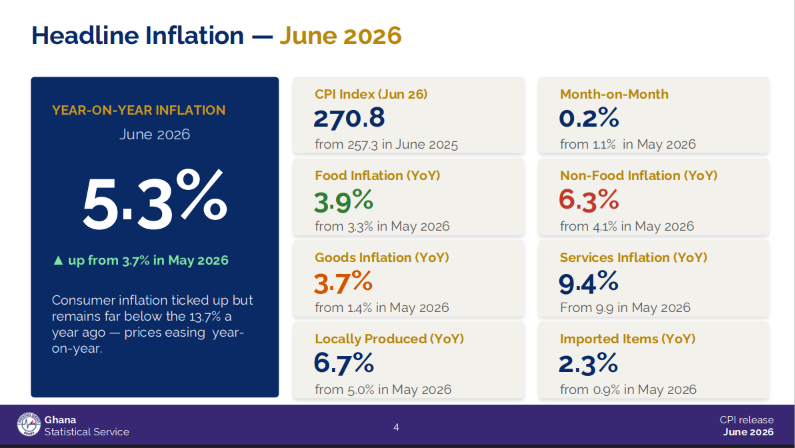
The country’s annual inflation rate rose to 5.3 percent in June 2026 from 3.7 percent in May, the third consecutive monthly increase after hitting a low of 3.2 percent in March 2026.
The increase was driven primarily by higher non-food prices and locally produced goods, although overall inflation remains significantly below the 13.7 percent recorded in June last year.
Data released by Ghana Statistical Service (GSS) showed that non-food inflation accelerated to 6.3 percent from 4.1 percent in May, contributing 68.5 percent of headline inflation while food inflation increased moderately to 3.9 percent from 3.3 percent.
Locally produced items recorded inflation of 6.7 percent compared to 2.3 percent for imported goods, underscoring domestic supply-side pressures as the dominant source of rising prices.

Month-on-month inflation
Despite the rise in annual inflation, month-on-month inflation slowed sharply to 0.2 percent in June from 1.1 percent in May – indicating that although prices continued to increase compared to a year earlier, the pace of price increases moderated during the month.
GSS noted that while inflation has edged upward over the last three months, the broader disinflation trend remains intact. However, June’s data signal increasing pressure from non-food categories, services and local production costs, which require close monitoring.

Transport emerged as one of the biggest contributors to inflation after recording a sharp increase to 9.1 percent from negative 2.8 percent in May. Housing, water, electricity, gas and other fuels registered inflation of 7.9 percent, while education services recorded 8.7 percent and restaurants and accommodation services rose 8.2 percent.
Food and non-alcoholic beverages remained the single largest contributor to headline inflation because of their large weight in the consumer basket, accounting for 31.5 percent of total inflation.

Regional disparities
Regionally, North East Region recorded the highest inflation rate at 10.2 percent while Bono East registered negative inflation of 4.4 percent, reflecting significant disparities in price movements across the country. Ashanti and Greater Accra together accounted for nearly two-thirds of headline inflation because of their large consumer spending weights.
Among individual products, ginger recorded the highest annual inflation at 102.5 percent, followed by shrimps at 90.8 percent and mango at 87.2 percent. On the other hand, prices of kontomire, garden eggs and maize declined significantly compared to the same period last year. Bus and trotro fares, rent, secondary school fees and cooked rice were among the largest contributors to overall inflation.
Recommendations
To cushion the impact of rising prices, GSS urged households to prioritise essential spending, plan purchases around lower-cost and seasonal food alternatives and regularly review household budgets while maintaining small cash buffers.
Businesses were advised to secure supplier agreements for key local inputs over the next 60 to 90 days, compare local and imported sourcing options and rely on structured pricing strategies rather than frequent ad hoc price increases to protect profit margins.
For government, the Statistical Service recommended maintaining macroeconomic discipline to avoid policies that could fuel demand-driven inflation, while intensifying efforts to address supply bottlenecks in storage, irrigation, transportation and market logistics. It also called for the use of regional inflation dashboards to target interventions more effectively in areas experiencing the highest price pressures.
GSS maintained that although June’s inflation increases warrants attention, the overall disinflation path has not been reversed with current inflation still less than half the level recorded a year ago.
It also said sustained attention to non-food inflation, services and domestic supply dynamics will be critical to preserving recent gains in price stability as policymakers seek to keep inflation on its broader downward trajectory.
Post Views: 26
Discover more from The Business & Financial Times
Subscribe to get the latest posts sent to your email.