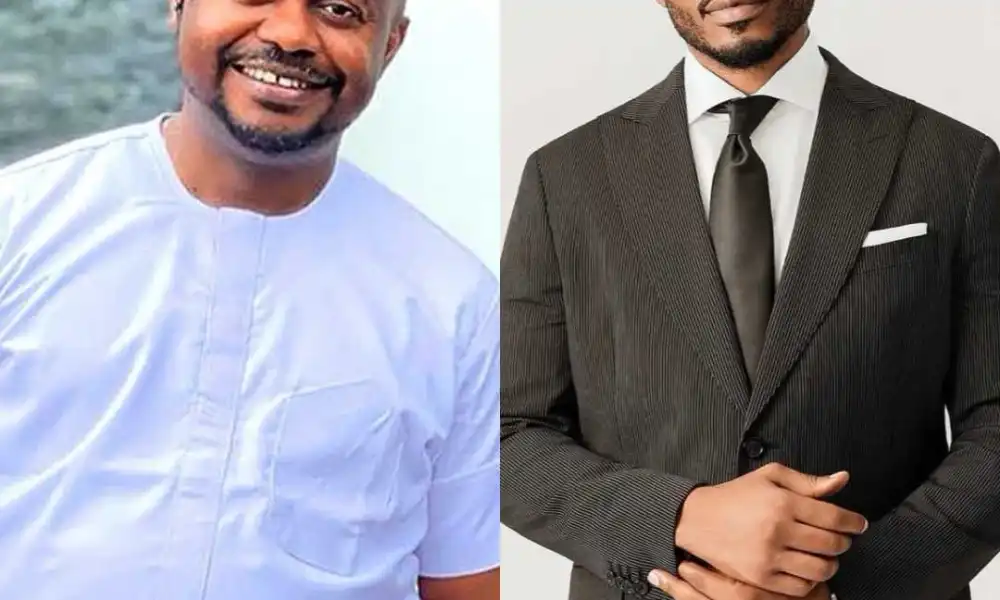
Popular Nigerian filmmaker Uchenna Mbunabo has expressed deep concern over the unauthorized broadcast of Nollywood films by some Ghanaian television stations, calling on Ghana’s National Film Authority (NFA) to urgently address what he described as a persistent infringement on Nigerian filmmakers’ intellectual property.
The producer made the remarks during a conversation with Ghanaian actor and Deputy CEO of the National Film Authority, James Gardiner, in the presence of celebrated actress Jackie Appiah.
Uchenna Mbunabo questioned whether it had become legal in Ghana for television stations to download newly released Nigerian movies from YouTube and broadcast them without obtaining permission from the producers.
“I noticed that Ghanaian TV stations, the way they are stealing our films and showing them for free with impunity. Is it legalized in your country for TV stations to go on YouTube, download people’s sweat and show it for free?” he asked.
The filmmaker lamented that the alleged practice has become increasingly common, with several Ghanaian television stations reportedly airing newly released Nollywood productions uploaded to YouTube as part of their official distribution strategy. According to him, the unauthorized broadcasts deprive producers of revenue generated through YouTube views, making it difficult for filmmakers to recover the substantial investments made in producing movies.
Uchenna further stated that although Nigerians are often associated with negative stereotypes, he has never witnessed Nigerian television stations downloading films from YouTube and airing them without authorization. He therefore questioned what concrete measures the Ghanaian government was taking to protect the intellectual property rights of filmmakers.
Responding to the concerns, James Gardiner acknowledged that the issue exists and admitted that he is equally disappointed whenever he comes across such unauthorized broadcasts. According to him, the National Film Authority has already begun engaging key stakeholders to tackle the problem.
He disclosed that the Authority has held discussions with Ghana’s Ministry of Communications, the National Communications Authority (NCA) and the National Media Commission (NMC), the institutions responsible for regulating the country’s television broadcasting space.
The award-winning actor explained that the NFA is working to strengthen the enforcement of Ghana’s copyright laws by bringing television stations under a more effective regulatory framework to curb copyright violations.
“There are copyright laws, but they are not effective because a lot of the TV stations don’t have offices. Most of them are now digital, so they operate from anywhere. They can even have a Ghanaian TV station but be operating from Austria simply because it is digital,” he said, noting that the changing broadcasting landscape has made regulation more difficult.
To address the problem, James Gardiner revealed that authorities are considering revoking existing broadcasting licences and requiring television stations to undergo a fresh licensing process that would enable stricter monitoring and enforcement of copyright regulations.
Read Also: Nosa Rex Slams Ghanaian TV Stations for Airing His New Movie Just a Few Hours After Release
When Uchenna asked how long the reforms would take and whether offending television stations would face sanctions, James Gardiner said the process was already underway but would require time to implement fully. He expressed optimism that significant changes should begin to take effect by next year.

On penalties, the Ghanaian actor stated that television stations found guilty of illegally broadcasting copyrighted content would be required to compensate the affected producers through fines imposed on them.
He further disclosed that repeat offenders would face escalating sanctions, including the suspension of their broadcasting licences after a second violation, while a third offence could result in the complete revocation of their licences, effectively preventing them from continuing operations.
Despite welcoming the proposed reforms, Mbunabo urged the National Film Authority to expedite the process, stressing that the continuous unauthorized airing of films has become both persistent and financially damaging for producers.
According to him, filmmakers invest enormous sums into producing movies and rely on platforms such as YouTube to recover those investments through legitimate viewership and advertising revenue. When television stations download and rebroadcast the films without authorization, producers lose a significant source of income.
Uchenna also emphasized that his comments were not an attack on Ghana or its film industry. He noted that he has consistently supported collaborations between Nollywood and Ghallywood by featuring numerous Ghanaian actors in his productions over the years.
Because of that longstanding relationship, he said, it is particularly painful to witness some television stations in Ghana allegedly exploiting the work of filmmakers without permission.
Describing the situation as disheartening, he appealed for stronger copyright enforcement to safeguard the future of African cinema and ensure that content creators receive fair compensation for their work.
Sharing the video online, Ben Cassie described the discussion as one that “needed to happen.”
She noted that Nollywood producers have, for years, complained about the unauthorized broadcast of their films by some Ghanaian television stations, stressing that these productions are not abandoned works but the result of years of hard work, sleepless nights, personal sacrifices, loans and millions invested by producers.
According to her, every unauthorized broadcast deprives filmmakers of the revenue needed to pay cast and crew members, finance future productions and sustain the industry.
Cassie also highlighted Mbunabo’s longstanding support for Ghana’s film industry, noting that the producer has consistently collaborated with Ghanaian actors and invested in projects that have strengthened ties between Nollywood and Ghallywood.
She stressed that the conversation was never intended to create division between the two film industries but rather to advocate fairness and respect for intellectual property.
“African cinema cannot thrive if the people who invest in telling our stories continue to watch their work taken without permission,” she wrote.