

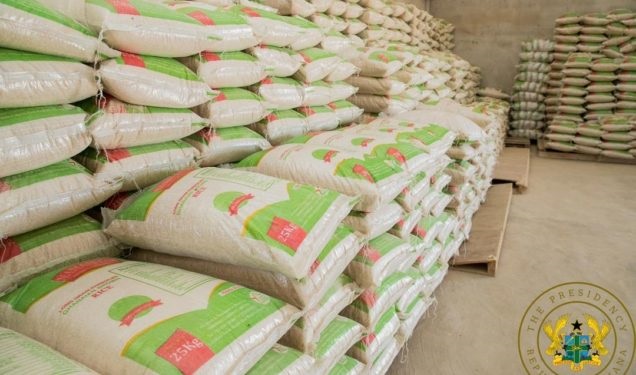
Following the glut in rice from the 2025 farming season to 2026, the National Food Buffer Stock Company (NAFCO) says it needs at least GH¢770 million to absorb the surplus.
Speaking in an interview with Accra-based Citi FM on Tuesday, May 5, 2026, the Senior Manager in charge of Corporate Affairs at NAFCO, Emmanuel Arthur, said purchases were still ongoing with the GH¢100 million released by the government in 2025.
The Senior Manager for Corporate Affairs at NAFCO, Mr Emmanuel Arthur, disclosed this in a radio interview on Citi FM on May 5, 2026.
He said NAFCO was still buying grain with the 2025 funds and had not exhausted the allocation.
“The buying is still ongoing,” he said. “We are left with a little, but we are still buying. As we speak, we have people on the ground purchasing.”
Mr Arthur did not readily provide a detailed breakdown of expenditure or volumes purchased as of now.
On the funding gap, he said the amount required to clear the glut far exceeds current allocations. “If we had told the government that we needed not less than GH¢770 million to mop up the surplus, that was what the farmers wanted,” he said.
“The government said there is a match, so it gave GH¢100 million for a start.”
He also said an additional GH¢200 million announced in the 2026 Budget by the Minister of Finance, Dr Cassiel Ato Forson, in November 2025 had not yet been released. “We are waiting for it. The GH¢200 million has not come yet,” he said.
The discussion followed a Business and Financial Times report published on May 4, 2026, in which an executive member of the Association of Ghana Rice Producers and Processors, Dr Terence Adda-Balinia, alleged that NAFCO had ignored a presidential directive to prioritise locally produced rice.
He claimed cheaper smuggled rice was being procured instead, forcing some millers to halt operations and leaving many farmers with losses.
Mr Arthur rejected the claim, stating that all grain purchased by NAFCO had come from local farmers. “Everything that we have bought has been from Ghanaian farmers,” he said.
He explained that the company works through licensed buying companies, which procure grain on its behalf and deliver to its warehouses.
He named facilities in Buipe, parts of the Bono and Ashanti regions, Jute in the Volta Region, and Tamale as storage points, and invited journalists to verify the stock.
“I will be happy to take your crew to these locations and you will see the quantity of grain we have bought with the GH¢100 million,” he said.
During the programme, a former Executive Secretary of the Ghana Rice Interprofessional Body, Mr Ivan Sakitei, said he still had thousands of bags of rice harvested in December 2025 unsold in Akuse.
He referred to a meeting held on April 15, 2026, with the Greater Accra Regional Minister, but said no progress had been made.
“We are yet to sell even one bag, even after these discussions and agreed prices,” Mr Sakitei said.
Mr Arthur acknowledged the concern and said such complaints should not be dismissed. He attributed the situation to limited funding.
“The amount of money is not enough,” he said. “It is difficult for people to feel the impact of what we are doing because the funds are not enough. If we had the means today, we would mobilise all the grain farmers have.”
The host of the programme, Mr Bernard Avle, called on NAFCO to publish a list of farmers and mills from which grain had been procured through licensed buyers.
“So long as you cannot give us that information and these recognised bodies say no one is buying their rice, it is difficult to clear yourself of that accusation,” he said.
Mr Arthur said the company would consider the suggestion. “That is not difficult to do and we will consider it,” he said.
He added that the World Food Programme was supporting NAFCO to rehabilitate storage facilities ahead of further purchases.
“They are helping us put our facilities in good shape in preparation for more procurement,” he said.
Akuse in the Lower Manya Krobo District of the Eastern Region and Asutsuare in the Shai Osudoku District of the Greater Accra Region remain major rice-producing areas. Both form part of the Kpong Irrigation Scheme, which spans about 4,040 hectares and supports more than 2,000 smallholder farmers.
President John Dramani Mahama on March 5, 2026, directed that rice procurement for schools be centralised under NAFCO, with priority given to locally produced rice for the School Feeding Programme and Free Senior High School.
Mr Arthur clarified that the GH¢100 million allocation is for the national food reserve, which is separate from the Free SHS supply chain, although both programmes require the use of local rice.
“The National Food Reserve Programme, which we are using the GH¢100 million for, is different from the Free SHS supply chain,” he said. “But the directive to use local rice applies to both.”
NAFCO was set up in 2010 under President John Evans Atta Mills to maintain a national food reserve and provide a market for farmers. Mr Arthur said the company had struggled to build reserves over the years until the recent glut prompted government action.
“For many years we have not had a proper national food reserve,” he said. “The current situation led to a directive for us to step in and buy excess grain from farmers across the country.”
DISCLAIMER: The Views, Comments, Opinions, Contributions and Statements made by Readers and Contributors on this platform do not necessarily represent the views or policy of Multimedia Group Limited.
DISCLAIMER: The Views, Comments, Opinions, Contributions and Statements made by Readers and Contributors on this platform do not necessarily represent the views or policy of Multimedia Group Limited.
Source link