

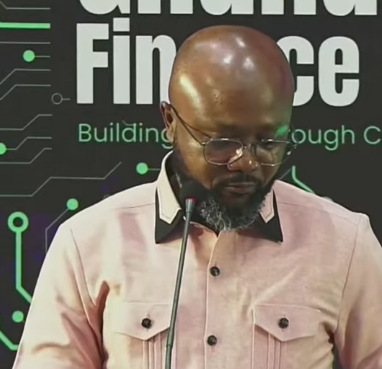
The Cyber Security Authority (CSA) says digital trust is essential to building a sustainable digital economy, stressing that cybersecurity remains fundamental to maintaining confidence in digital platforms and services.
The Director-General of the CSA, Divine Selase Agbeti, said the impact of cyber fraud extends beyond the immediate financial loss suffered by victims, as such incidents can also undermine public confidence in the digital ecosystem.
He made the remarks at the 2026 National Cyber Security Awareness Month, held under the theme “Securing Ghana’s Digital Finance Ecosystem,” at the University of Ghana on October 1.
Mr Agbeti said when citizens lose confidence in digital platforms, the effects can extend beyond individual victims to areas such as financial inclusion, electronic commerce, innovation, and Ghana’s wider digital transformation agenda.
“When a Ghanaian loses money to cyber fraud, we lose more than money; we lose confidence,” he said.
He said maintaining public confidence in digital services was therefore important to the continued development and adoption of the digital economy.
“Our message at the Cyber Security Authority is therefore simple: there can be no sustainable digital economy without digital trust, and there can be no digital trust without cybersecurity,” Mr Agbeti said.
Need for collaboration
Mr Agbeti said the theme for the 2026 National Cyber Security Awareness Month deliberately emphasises collaboration because cybercriminals do not operate within institutional boundaries.
He said criminals could target different parts of the digital ecosystem without regard to whether an incident involved a bank, fintech company, telecommunications operator, regulator, or law enforcement agency.
“They exploit the gaps between our institutions. Our response must therefore be equally connected,” he said.
Against this backdrop, Mr Agbeti called for stronger information-sharing among institutions operating within Ghana’s digital finance ecosystem.
“We need financial institutions to share actionable threat intelligence. We need telecommunications companies to work closely with banks and fintechs,” he said.
He also called for closer cooperation among regulators, technology companies, law enforcement agencies, and cybersecurity service providers, saying information needed to be exchanged quickly enough to help disrupt attacks before they resulted in losses.
“We need regulators, technology companies, law enforcement agencies, and cybersecurity service providers to exchange information quickly enough to disrupt attacks before losses occur,” he said.
Faster response needed
Mr Agbeti said cybersecurity should not be approached as a competition among institutions responsible for defending the digital space.
He stressed that effective protection required institutions to share relevant information when threats were identified so that others could take preventive action.
He explained that a threat detected by one institution could potentially be used against another if the relevant intelligence was not shared.
“If one institution detects an attack today, and another experiences the same attack tomorrow, because intelligence was not shared, we have collectively failed,” he said.
According to Mr Agbeti, the effectiveness of collaboration should therefore be measured by how quickly institutions are able to identify threats, share relevant information, respond to incidents, and recover from them collectively.
He said a connected approach to cybersecurity was necessary to strengthen Ghana’s digital ecosystem and protect the confidence of citizens and businesses using digital services.
The CSA’s message forms part of efforts under the 2026 National Cyber Security Awareness Month to promote greater awareness of cybersecurity and encourage stronger cooperation among institutions across the digital economy.
DISCLAIMER: The Views, Comments, Opinions, Contributions and Statements made by Readers and Contributors on this platform do not necessarily represent the views or policy of Multimedia Group Limited.
DISCLAIMER: The Views, Comments, Opinions, Contributions and Statements made by Readers and Contributors on this platform do not necessarily represent the views or policy of Multimedia Group Limited.
Source link