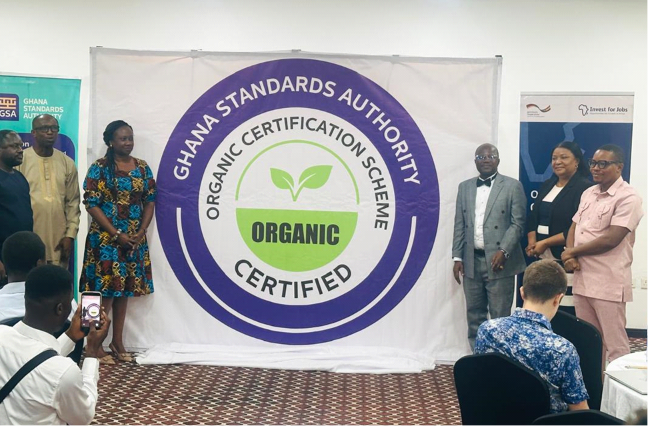

- As GSA prepares 1st national certification
- Move will unlock US$220billion market
By Ernest Bako WUBONTO
A Ghanaian farmer who rises before dawn, nurtures the soil without synthetic fertilisers and diligently brings produce to market deserves greater recognition and reward for such commitment, Director-General of the Ghana Standards Authority (GSA) Prof. George Agyei has argued.
According to GSA, however, the reality has long been different. In the absence of a credible national verification framework, farmers committed to organic cultivation have been unable to distinguish their produce from conventionally grown alternatives – forcing both to compete in the same marketplace.
As a result, organic producers have been denied access to lucrative premium markets in Europe and North America, where certified organic products can command price premiums of between 20 and 40 percent.
To correct this structural injustice, GSA in partnership with the German Development Cooperation (GIZ) convened a landmark stakeholder engagement in Accra to advance the establishment of Ghana’s first nationally-managed ‘Organic Certification Scheme’.
Supported by a robust testing and conformity assessment framework, the project is officially entering its final phase before implementation.
GSA certification is built on the international standard ISO/IEC 17065, the standard for bodies certifying products, processes and services and is aligned with the European Union’s Organic Regulation 2018/848.
The scheme covers crops, horticultural products, fruit and vegetables – the commodities which define Ghana’s agricultural export identity.
Its certification cycle follows a rigorous four-stage process of application, audit, certification decision and ongoing surveillance, deliberately designed as a living system of accountability rather than a one-time stamp.
The global organic food and beverage market was valued at over US$220billion in 2024 and is projected to surpass US$380billion by 2030.
Europe alone represents more than a third of consumption and the EU’s ‘Farm to Fork Strategy’ targets 25 percent of all agricultural land under organic production by end of the decade.
For a country that grows cocoa, shea, cashew, tropical fruits, spices and vegetables, the opportunity is immense – but positioning without a passport, which is an approved certification, means nothing, the Director-General emphasised.
“In international trade, that passport is certification; credible, traceable, internationally recognised certification and without it, our farmers export under someone else’s mark. They bear the cost of organic production but capture none of the premium,” said Prof. Agyei.
The Director-General revealed that this initiative is backed by significant investments in laboratory testing infrastructure and technical capacity, a trajectory accelerated by a strategic working visit in March 2025 to Indocert in Kerala, India.
During that visit, technical teams underwent practical training in certification management systems, auditor competency and inspection procedures to ensure Ghana’s framework meets international best practices while remaining affordable for local small- and medium-sized enterprises (SMEs).
The Director-General gave rare public acknowledgment to the German government for what he described as “a partnership of substance”.
“They did not come to Ghana with a solution looking for a problem; they came to build capacity alongside us, to co-invest in a system that will outlast any project cycle,” he added.
Component Head of the Invest for Jobs programme at GIZ Ghana, Eunice Agyeiwah Agyepong, representing GIZ which has co-invested in the scheme under the German Federal Ministry for Economic Cooperation and Development (BMZ), traced the partnership back to December 2022. At the time, she recalled, access to certification was a punishing bottleneck.
Many businesses relied on foreign certification bodies at costs that effectively priced smallholder farmers out of the very markets their labour sustained.
“Many businesses relied on foreign certification bodies, often at considerable cost. The process could be complex, time-consuming and difficult for small- and medium-sized enterprises to navigate. That is why the national organic certification scheme is so important. It is not simply about issuing certificates. It is also about building trust,” she added.
AfCFTA Opportunities
The Director-General argued that under the African Continental Free Trade Area (AfCFTA), Ghana has the institutional mandate anchored by the Standards Authority Act 2022, Act 1078, to become the preferred organic certification destination for the West African sub-region.
A farmer in Côte d’Ivoire, a processor in Senegal or an exporter in Burkina Faso should eventually be able to secure GSA organic certification accepted in London, Brussels and Tokyo, he emphasised.
“This is what national standards bodies are for, not just to regulate but also unlock – build the infrastructure that makes trade possible, that makes quality visible and that makes fairness enforceable,” he added.
He stressed that the scheme’s imminent launch will not be the end of the journey, calling on producers, processors, retailers and supermarket chains to enforce proper segregation of organic products from conventional ones on the domestic market.
He also urged consumers to patronise well-branded certified organic goods and asked all stakeholders to become ambassadors for a system that will need sustained commitment to deliver on its promise of increased incomes, market access and decent jobs.
All of the above is commendable and very welcome. However, no mention is made of how this will manifest in our local markets. Ordinary Ghanaians who depend on local markets also deserve an opportunity to buy chemical-free produce that they can enjoy without fear. It is the hope of this publication that this issue will be addressed before the scheme’s full rollout so all our people can enjoy safe, toxin-free food.
Post Views: 1
Discover more from The Business & Financial Times
Subscribe to get the latest posts sent to your email.