
Legal luminary Prof Kwaku Asare has raised a series of legal questions over the prosecution’s case against senior nursing officer Salomey Awiti Baffoe, who has been remanded for two weeks over alleged links to the anonymous ‘Ghana Jollof’ TikTok account.
Prof Asare said the amended charge sheet and police brief facts he had reviewed did not, on their face, clearly establish how Ms Baffoe allegedly facilitated the specific offence with which she has been charged.
In a Facebook post on Thursday, September 17, Prof Asare said his observations were limited to the court documents available to him and that he had not watched any of the videos at the centre of the case.
Ms Baffoe, 40, was arrested at her home in Hansua in the Techiman Municipality of the Bono East Region on September 13 and subsequently appeared before the Adenta Circuit Court.
She has been charged with abetment of crime, to wit, publication of false news, contrary to sections 20(1) and 208 of the Criminal Offences Act, 1960 (Act 29).
The charge alleges that on or before September 13, 2026, in Accra and within the jurisdiction of the court, Ms Baffoe aided or abetted Barbara Asantewaa Kodua to publish and circulate false news on TikTok by serving as her liaison.
According to the police brief facts, Ms Kodua allegedly produced videos containing “offensive and inciting statements” capable of provoking violence, including an alleged threat to overthrow the government and burn Ghana.
The police further allege that Ms Baffoe collaborated with Ms Kodua, recruited others to redistribute the videos, received money from her and distributed portions of the money to others involved in circulating the content.
Prof Asare, however, said the description of the videos in the police brief raised questions about whether the facts presented corresponded with the specific offence charged.
“Offensive, inciting, threatening and false do not mean the same thing in law,” he wrote.
He said an alleged threat to overthrow a government or burn a country did not, without more, establish the publication of a false statement, rumour or report under section 208.
“A threat to do something in the future is not, without more, a false statement, rumour or report,” he said.
Read Also: Senior nursing officer remanded for 2 weeks over alleged links to ‘Ghana Jollof’ TikTok Account
Questions over alleged abetment
Prof Asare said the prosecution would have to establish that Ms Baffoe purposely assisted, facilitated, encouraged or promoted the commission of the particular offence with which she is charged.
He questioned whether the available documents identify the specific statement, rumour or report alleged to be false, explain what made it false and establish what Ms Baffoe knew or had reason to believe about its falsity.
He also questioned what she specifically did in her alleged role as a “liaison” and how the alleged payments were connected to the publication of the identified false news.
“‘Serving as liaison’ could amount to abetment if it involved purposeful assistance in publishing identified false news,” Prof Asare said.
“But ‘liaison’ merely describes a relationship unless the prosecution identifies the acts performed and their criminal purpose.”
He said the alleged receipt or distribution of money could potentially be relevant to establishing coordination, but argued that coordination itself did not constitute a crime.
“The money must be connected to the purposeful facilitation of the specific offence charged,” he wrote.
Prof Asare acknowledged that the prosecution was not required to put all its evidence in the charge sheet, but said the accused must be given reasonable information about the accusation she was required to answer.
“The investigation may eventually supply these missing particulars. The documents presently available do not,” he said.
Questions over two-week remand
Prof Asare also questioned the basis for Ms Baffoe’s continued detention.
She reportedly pleaded not guilty and was remanded for two weeks, with national security concerns and the continuing investigation cited in connection with the case.
Prof Asare said he had not seen a written ruling setting out the court’s full reasoning and was therefore commenting only on reasons publicly reported.
He noted that the law permits bail to be refused where specific risks exist, including the possibility that an accused person may abscond, interfere with witnesses or evidence, hamper investigations or commit another offence.
He questioned whether such risks had been demonstrated in Ms Baffoe’s case.
“‘National security’ is not a self-executing incantation that automatically displaces personal liberty,” he wrote.
“Nor does ‘investigations are ongoing’ by itself justify imprisonment. Almost every police investigation would satisfy that formula.”
Prof Asare said the court would need to identify the concrete risk posed by releasing Ms Baffoe and consider whether any such risk could be addressed through appropriate bail conditions.
He noted that the police describe her as a nurse residing in Techiman, where she was reportedly arrested, but said the brief facts available to him did not identify any previous failure to appear, attempt to flee, destruction of evidence or threat to a witness.
“The fact that the police are looking for other participants may be relevant if there is evidence that Awiti might alert, conceal or improperly influence them,” he said. “But that risk must be demonstrated rather than presumed.”
Prof Asare questions Adenta jurisdiction
The law professor also questioned the territorial basis for prosecuting Ms Baffoe before the Adenta Circuit Court.
The amended charge alleges that she acted “in Accra and within the jurisdiction of this court”.
However, Prof Asare noted that the police brief reportedly states that Ms Baffoe resides in Techiman, where she was arrested, while Ms Kodua is domiciled in the United Kingdom.
He said the documents he had reviewed did not identify any act allegedly performed by Ms Baffoe in Accra or Adenta, or any relevant consequence that occurred there.
“Nationwide accessibility of a TikTok video does not necessarily make every court in Ghana a proper venue,” he said.
He added that the police could not establish territorial jurisdiction merely by transporting Ms Baffoe from Techiman to Adenta.
Prof Asare said Adenta could be a proper venue if the prosecution established that Ms Baffoe committed an act constituting the alleged abetment, recruited someone, distributed funds, facilitated publication or caused a relevant consequence within the court’s jurisdiction.
“But none of those connections appears in the brief facts,” he said.
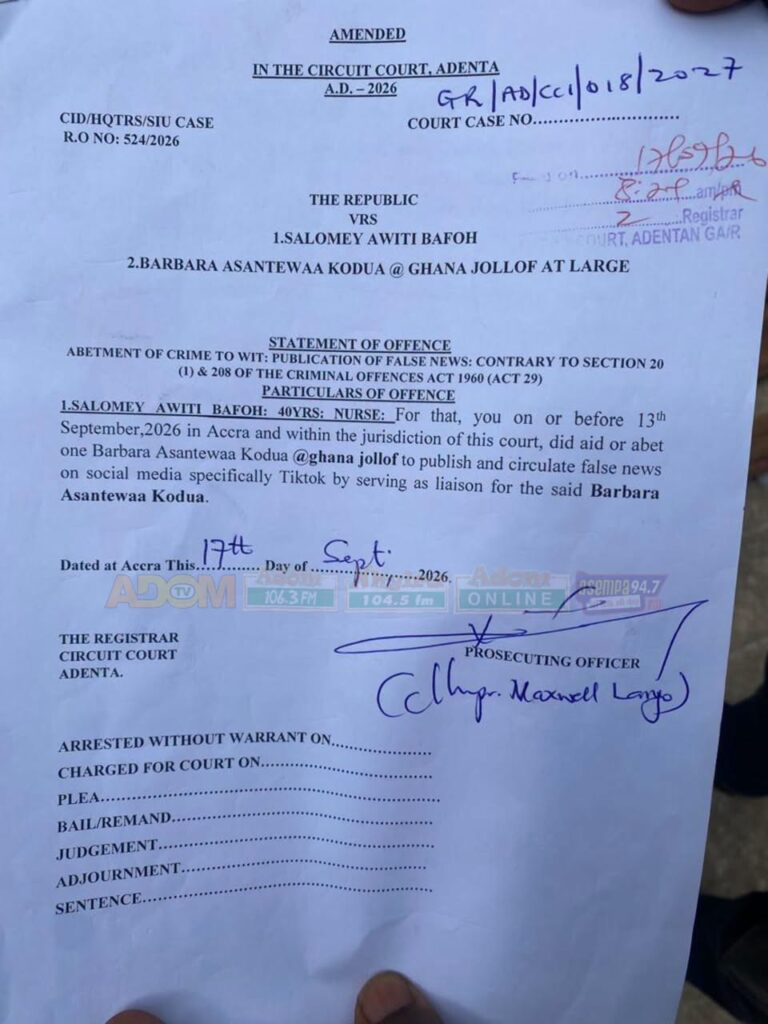
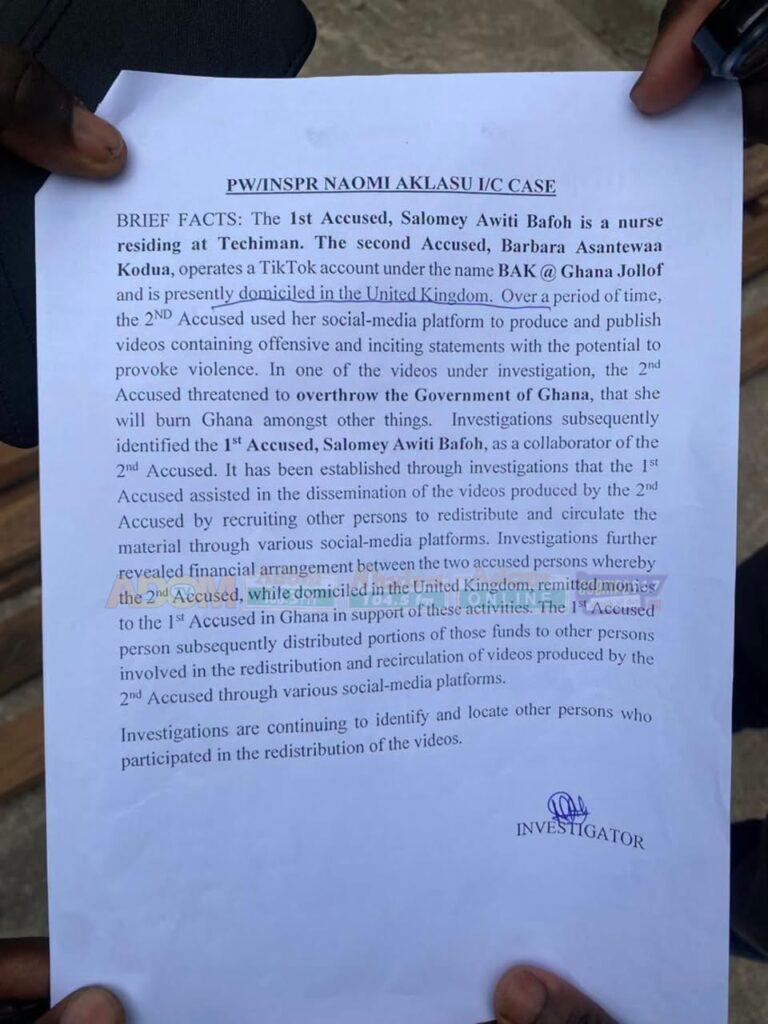
He therefore posed the question: “What act constituting the alleged abetment occurred within the territorial jurisdiction of the Adenta Circuit Court, or what legally relevant consequence ensued there?”
‘Serious case’ must still meet due process requirements
Prof Asare stressed that his observations should not be interpreted as a defence of alleged threats, incitement or false publications.
Rather, he said the State must identify the alleged false statement, establish what made it false, connect Ms Baffoe purposefully to its publication, justify any deprivation of her liberty and establish the factual basis for proceeding in Adenta.
“The more serious the State says a case is, the more, not less, it must observe the disciplines of criminal law and due process,” he said.
DISCLAIMER: The Views, Comments, Opinions, Contributions and Statements made by Readers and Contributors on this platform do not necessarily represent the views or policy of Multimedia Group Limited.
DISCLAIMER: The Views, Comments, Opinions, Contributions and Statements made by Readers and Contributors on this platform do not necessarily represent the views or policy of Multimedia Group Limited.
Source link