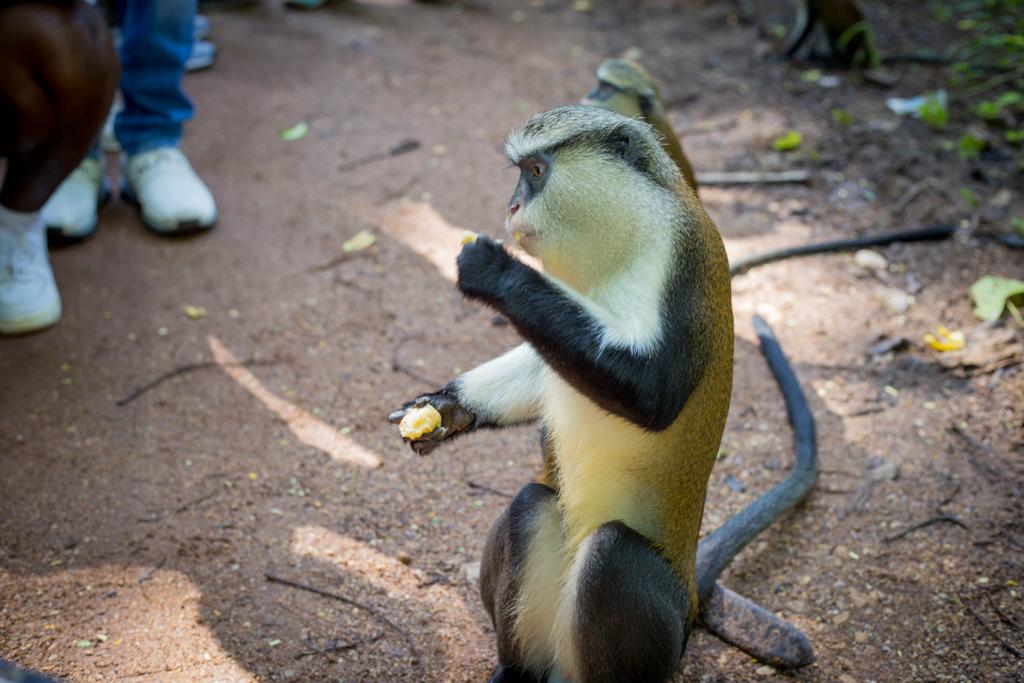
The possible extinction of one of West Africa’s rarest monkeys should serve as a wake-up call for governments and communities to protect nature before more species and the ecosystems people depend on are lost, a leading Ghanaian biodiversity scientist has warned.
Pro Vice-Chancellor of the University of Environment and Sustainable Development (UESD), Professor Edward Wiafe Debrah, said the disappearance of Miss Waldron’s red colobus monkey, once found in the forests of Ghana and Côte d’Ivoire, reflects the growing pressure on biodiversity across the region.
Speaking during a virtual media engagement organised by the West African Journalists for Environment, Science, Health and Agriculture (WAJESHA), Professor Debrah said biodiversity loss now threatens far more than wildlife.
“The issue is for us to act now. Protect nature and secure our future,” he said.
Scientists have not conclusively recorded Miss Waldron’s red colobus in the wild for decades, and the species is now widely considered possibly extinct. Conservation experts believe intensive hunting and the destruction of its forest habitat largely drove its disappearance.
Professor Debrah said the monkey’s decline should not be viewed simply as the loss of another animal species.
“It is a reminder of what happens when ecosystems are not adequately protected,” he said. “Protecting biodiversity, he said, is not simply about preserving wildlife, but it is about protecting our food, our health, our economy, our climate and the future of generations yet unborn.
He explained that biodiversity underpins agriculture, fisheries, forestry, tourism, medicine and many other sectors that sustain livelihoods across West Africa.
Nearly three-quarters of the world’s food crops, he noted, depend at least partly on animal pollination.
“Without bees and other pollinators, food production declines. Protecting biodiversity means protecting our food, our health and our future,” he said.
Although Africa remains one of the world’s richest regions in biodiversity, Professor Debrah warned that forests, wetlands, rivers and coastal ecosystems are facing increasing pressure from deforestation, illegal mining, agricultural expansion, pollution, climate change, invasive species, illegal wildlife trade and unsustainable harvesting.
In Ghana, he said these pressures are evident in degraded forests, polluted rivers, disappearing wetlands, bushfires, habitat fragmentation, coastal erosion and declining wildlife populations.
According to him, reversing the trend will require stronger investment in protected areas, community-based conservation, mangrove restoration, sustainable agriculture, scientific research and the strict enforcement of environmental laws.
He also stressed that women, young people and indigenous communities must play a central role in protecting natural resources.
Beyond conservation, Professor Debrah challenged journalists to help the public understand why biodiversity matters to everyday life.
Rather than focusing only on environmental destruction, he encouraged reporters to explain how biodiversity affects food security, public health, climate resilience, livelihoods and economic development.
“People protect what they understand,” he said, urging journalists to simplify scientific information, investigate environmental crimes, challenge misinformation with evidence and highlight practical solutions.
Commenting on the engagement, WAJESHA Director, Engr. Mahmud Mohammed-Nurudeen, said science journalism has become increasingly important as environmental issues affect every aspect of society.
“Biodiversity is no longer a subject for scientists alone. It is central to agriculture, health, climate resilience, food security and economic development across West Africa,” he said.
He said WAJESHA’s continuing professional development programme connects journalists with scientists and researchers to strengthen evidence-based reporting that can inform policy, empower communities, and support sustainable development across the region.
DISCLAIMER: The Views, Comments, Opinions, Contributions and Statements made by Readers and Contributors on this platform do not necessarily represent the views or policy of Multimedia Group Limited.
DISCLAIMER: The Views, Comments, Opinions, Contributions and Statements made by Readers and Contributors on this platform do not necessarily represent the views or policy of Multimedia Group Limited.
Source link