

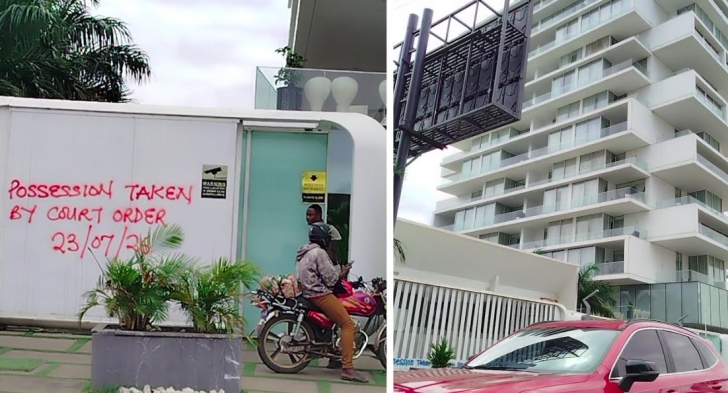
No. 1 Oxford Street Hotel
The legal battle over the No. 1 Oxford Street Hotel in Accra has taken a fresh turn, with the Receiver/Manager of the property, Nii Amanor Dodoo, and Cola Holdings Ltd filing an appeal against a High Court order directing that the hotel be handed back to Kensington Residential Partners 1 Ltd.
The appeal was filed after the High Court, Accra, Commercial Division 2, sitting as a vacation court on Friday, August 21, 2026, set aside the Receiver’s possession of the property and ordered its re-delivery to Kensington Residential Partners 1 Ltd, owned by businessman Nana Kwame Bediako, commonly known as Cheddar or Freedom Jacob Caesar.
The Receiver has also applied for a stay of execution of the order pending the determination of the appeal.
The application and accompanying affidavit, filed in connection with the dispute, contend that the ruling contained serious errors of law and that the court that heard the matter did not have jurisdiction to do so.
The case centres on the Receiver’s possession of the hotel under arrangements involving Cola Holdings Ltd and the subsequent challenge by Kensington Residential Partners 1 Ltd.
Receiver challenges ruling
In the affidavit in support of the stay application, Nii Amanor Dodoo, who describes himself as the Receiver/Manager appointed by Cola Holdings Ltd to realise its security rights over the property, said the High Court ruling required him to immediately surrender possession of the hotel.
He further stated that the court made additional orders concerning steps he had taken after assuming possession of the property.
The Receiver strongly disagreed with the decision and maintained that it was legally flawed.
“I am advised by counsel and verily believe that the ruling of His Lordship Justice John-Mark Nuku Alifo is patently in error,” the affidavit stated.
According to the Receiver, the decision was inconsistent with provisions of the Borrowers and Lenders Act, 2020 (Act 1052), particularly provisions relating to the enforcement of security interests when a borrower is in default.
He argued that the ruling effectively required the restoration of conduct which, in his view, the law criminalises.
“I am advised by counsel that the ruling flies in the face of the statutory provisions in the Borrowers and Lenders Act, 2020 (Act 1052) including provisions which make it a criminal offence for a borrower in default to stand in the way of possession being taken by the lender against a registered security interest. The ruling, in effect, is seeking to have criminal conduct restored,” he stated.
Jurisdiction becomes key issue
A major plank of the appeal is the contention that the vacation judge who heard the application did not have jurisdiction over the particular case.
The Receiver’s affidavit states that the substantive matter was pending before Commercial Court 6, while the Judicial Service’s published arrangement for the vacation courts indicated that cases from Commercial Court 6 were to be assigned to the vacation judge sitting in Commercial Court 8.
The affidavit said counsel for the Receiver initially went to Commercial Court 8 to ensure that the case was placed on the docket, but was informed that the docket was not available there.
It was subsequently discovered that the matter had instead been sent to Commercial Court 2.
The Receiver said the clerk at Commercial Court 2 could not explain why the docket had been brought to that court.
The affidavit further states that another application connected to the dispute, involving a request for an injunction, had also apparently been placed before Commercial Court 2, although it was expected to go before Commercial Court 8.
That application was not heard by the vacation judge and was instead deferred for determination by the substantive judge on October 22, 2026.
The Receiver therefore questioned why the application resulting in the August 21 ruling had proceeded before Commercial Court 2.
“It is not at all clear why His Lordship proceeded with hearing and ruling on an application which, according to the clear indication on the Judicial Service website, ought not to have been before him,” the affidavit stated.
“Not having a warrant in respect of this suit, His Lordship had no jurisdiction in connection with it.”
Constitution and Borrowers and Lenders Act cited
The Receiver has also challenged the ruling on constitutional and statutory grounds.
He contends that the decision was inconsistent with Article 296 of the 1992 Constitution, which governs the exercise of discretionary powers by public authorities.
The appeal further argues that the High Court fundamentally misinterpreted the nature of a warrant for police assistance issued under Section 64 of the Borrowers and Lenders Act.
According to the Notice of Appeal, the Receiver and Cola Holdings contend that the judge wrongly interpreted the warrant for police assistance as a warrant to take possession of the property.
They are also challenging the decision on the basis that it was inconsistent with an earlier Court of Appeal decision cited in their submissions.
The Notice of Appeal states that the appellants are dissatisfied with “the whole decision” and allege, among other things, “patent errors of law”.
The appellants are seeking an order from the Court of Appeal setting aside the August 21 decision.
Stay application
The Receiver has urged the High Court to suspend the execution of its order while the appeal is pending, arguing that the appeal has a strong prospect of success.
The affidavit describes the ruling as “unreasonable and irrational” and argues that immediate enforcement could have significant consequences for the parties involved in the dispute.
“It is, therefore, in the interest of justice that execution of the orders of His Lordship be stayed pending an appeal which stands a great chance of success,” the affidavit states.
The Receiver further indicated that, upon receiving the full ruling, his lawyers could take additional legal steps if the High Court did not set aside its decision.
He said counsel would also, as a preliminary matter, ask the judge to correct what they consider to be an error in hearing and determining the application when the judge’s authority as a vacation judge allegedly did not extend to the case.
The legal contest over the hotel therefore remains unresolved, with the next significant steps expected to centre on the application for stay of execution and the appeal before the Court of Appeal.
The stay application has been scheduled for hearing on October 16, 2026.
DISCLAIMER: The Views, Comments, Opinions, Contributions and Statements made by Readers and Contributors on this platform do not necessarily represent the views or policy of Multimedia Group Limited.
DISCLAIMER: The Views, Comments, Opinions, Contributions and Statements made by Readers and Contributors on this platform do not necessarily represent the views or policy of Multimedia Group Limited.
Source link