By Owusu Emmanuella Akoto
The Environmental Protection Authority (EPA) says the ban on polystyrene and styrofoam products will take effect on January 1, 2027, as it takes its public education campaign to five regions in Northern Ghana.
The Deputy Director of Environmental Education at the EPA, Dr. Frederick Ofori-Nuako, said this on GTV’s Breakfast Show, which he joined via Zoom from the Northern Region.
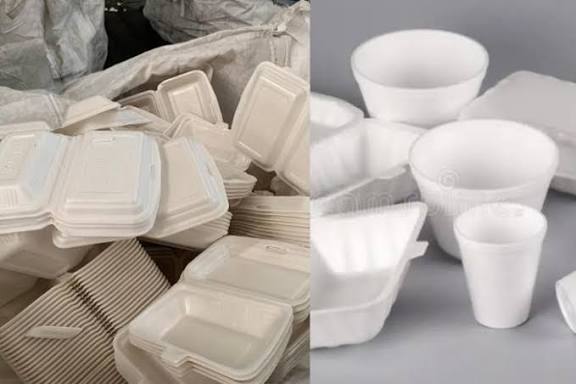
The ban on styrofoam, popularly known as takeaway packs, was announced by President John Dramani Mahama in June over health and environmental concerns.
The campaign is led by the EPA’s Chief Executive Officer, Prof. Nana Ama Browne Klutse. It runs from October 25 to 30 and covers the Savannah, Northern, North East, Upper East and Upper West regions.
Dr. Ofori-Nuako said the response so far has been positive, and also shared that the campaign began with a float through town, where EPA staff shared flyers and placards carrying key messages on the ban.
“We are going to every city, every home, all the markets have been activated. We are not going to leave any stone unturned because it concerns our life, our health, sanitation and flooding,” he said.
He said staff are also engaging market women and traders one-on-one and also quiz competitions and debates are planned among university students.
“We are engaging market women and traders one-on-one in the markets so that by the time we cross over to 12 o’clock on January 1st 2027, everyone is aware that implementation will take effect,” he explained.
The campaign will end with a grand durbar in Tamale on Thursday, bringing together EPA offices from Damongo and surrounding areas, along with management and headquarters staff from Accra.
“It will be very positive. Management team are fully prepared. We are inviting GTV viewers especially those within the coverage to be around to educate the general public on the ban,” he said.
Dr. Ofori-Nuako said manufacturers and importers are bringing in new alternatives, which will bring prices down. He advised traders to venture into alternative packaging to create more business for themselves.

Asked what those alternatives are, he urged Ghanaians to return to traditional and biodegradable packaging.
“When we were young, when we were being sent to go and buy food for our father, we were using the normal bowl, put it in a basket and cover it with a table cover. We should go back to that level,” he said.
He listed plantain leaves, paper cups, paper plates, paper bags, calabash, ceramic bowls and aluminium foil as options.
“Those ones are biodegradable. When it falls, the elements can act on it. But when it comes to styrofoam, it is single use only and the rippling effect is not helping us,” he said.
Dr. Ofori-Nuako said styrofoam belongs to the polystyrene family and is made from petroleum. He warned that regular use for hot food carries serious health risks, including cancer and kidney problems.
“When you buy hot food and put it in the takeaway container, it is like you are buying your food and putting petrol in it. The chemical reaction that takes place is very serious,” he said.
He added that styrofoam waste is a major cause of flooding and poor sanitation, as the containers clog drains and float in flood waters.
“Yesterday for instance, after it rained in Accra, the major commodity you could find is the takeaway containers in flowing floodwaters,” he noted.
On compliance, Dr. Ofori-Nuako said the EPA has already met key players in the supply chain. He said EPA teams have also held activations at the Makola, Tema Station and Agbogbloshie markets in Accra.
“Management and my boss the CEO met the manufacturers, importers, traders, every player in the distribution chain has been engaged,” he said.
He assured traders that the EPA does not intend to disrupt their businesses.
“We are not trying to disturb anybody’s livelihood. We know that is what they are getting money from but health wise cannot be compromised,” he said.
He called on chiefs, family elders, opinion leaders and all Ghanaians to join the fight against polystyrene pollution, pointing to Rwanda as an example.
“When you go to Rwanda right now, styrofoam products are not used there. Rwanda happens to be the cleanest country in Africa now because of their sanitation and environmental claim. We can also do that,” he said.
The EPA says the nationwide campaign will continue until the deadline