
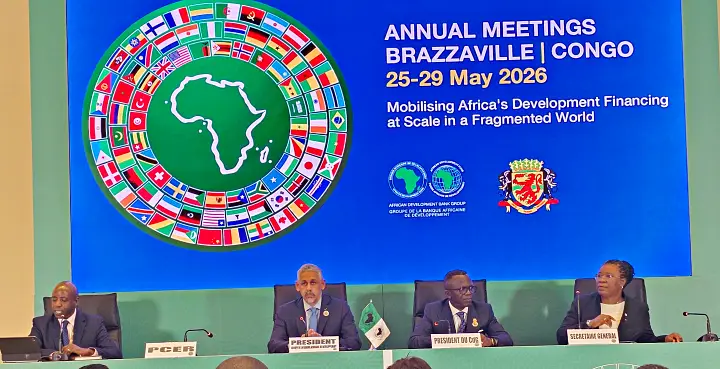
The 2026 Annual Meetings of the African Development Bank (AfDB) Group concluded in Brazzaville with strong support from African governors for the Bank’s new strategic direction, centered on a proposed African Financial Architecture for Development and a four-pillar agenda aimed at accelerating the continent’s structural transformation.
Speaking at the closing press conference, Congo’s Minister of Finance and Chair of the Annual Meetings, Christian Yoka, described the gatherings as “a great success for Africa,” highlighting the election and leadership transition at the Bank as a significant moment for the continent.
“We have endorsed the major orientations of the Bank, its future strategy and, in particular, the accelerated implementation of the action plan proposed by the President around his vision of the four cardinal points,” Yoka said.
The meetings marked the first annual gathering under the leadership of AfDB President Dr. Sidi Ould Tah, who used the event to present his vision to governors and secure broad support for the Bank’s next phase of development.
According to Ould Tah, the meetings resulted in strong backing for a new African Financial Architecture for Development, a framework designed to better coordinate Africa’s financial ecosystem and mobilize significantly larger pools of capital for development.
“The Board expressed its full support for the implementation of the African Financial Architecture for Development, in line with the Abidjan Consensus, and mandated the African Development Bank to take all necessary measures to move rapidly into action,” he said.
Moving Beyond Small Projects
Responding to questions from journalists about the Bank’s new emphasis on large-scale development projects, Ould Tah argued that Africa must fundamentally rethink how it finances its development.
He pointed to what he described as one of Africa’s greatest paradoxes: a continent that accounts for 18% of the world’s population and possesses vast mineral, agricultural and natural resources, yet contributes only a small share of global GDP.
“We cannot continue to rely solely on public financing or continue implementing small projects if we want to transform our economies,” he said. “We need large-scale projects that create jobs, add value to our resources and generate growth.”
The AfDB president stressed that the new approach would not come at the expense of small businesses or grassroots development initiatives. Instead, the Bank intends to work more closely with national development banks, commercial banks, guarantee funds and other financial institutions to ensure support reaches small and medium-sized enterprises, women entrepreneurs and young people.
“The principle is subsidiarity,” he explained. “The institution closest to the beneficiary should take the lead, while the larger institutions provide support, coordination and risk-sharing.”
Unlocking African Capital
A central theme of the discussions was Africa’s persistent financing gap, estimated at approximately $400 billion annually.
Ould Tah noted that despite this gap, the continent holds an estimated $4 trillion in domestic savings that remain largely disconnected from development financing.
One of the major obstacles, he said, is risk perception, which discourages institutional investors such as pension funds from investing in African projects.

To address this challenge, the Bank is advancing new risk-mitigation mechanisms, including the African Development Fund’s recently strengthened participation in the African Trade and Development Fund (ATDF), which is expected to help de-risk investments and attract greater private capital into development projects.
“The issue is not necessarily a lack of capital,” he said. “The challenge is creating the conditions that allow African savings to be invested in African development.”
Demographic Dividend and Industrialization
The AfDB also reiterated its commitment to helping African countries capitalize on their rapidly growing populations through investments in technical and vocational education, skills development and support for micro, small and medium-sized enterprises.
Ould Tah emphasized that the continent must also focus on processing its natural resources locally rather than exporting them in raw form.
Using bauxite as an example, he noted that African countries export the mineral at relatively low prices while importing much higher-value aluminum products.
“The objective is to create value and jobs in Africa,” he said. “The future lies in transforming African resources on African soil.”
Praise for Congo’s Hosting
Both Yoka and Ould Tah praised the Republic of Congo for successfully hosting the meetings despite a challenging global environment and regional health concerns that threatened to disrupt attendance.
Ould Tah singled out President Denis Sassou Nguesso, the Congolese government and people for delivering what he described as an exceptionally well-organized event.
“Despite the difficult global context, the organization was excellent, the discussions were rich and the decisions were important,” he said. “These Annual Meetings will be remembered as a success.”
The Brazzaville meetings are expected to shape the Bank’s strategic direction over the coming decade as it seeks to position itself as a catalyst for large-scale investment, economic integration and structural transformation across Africa.
Governors concluded the meetings by formally validating the roadmap presented by the AfDB president, giving the Bank a mandate to advance its four-pillar vision and accelerate implementation of the proposed African Financial Architecture for Development.