

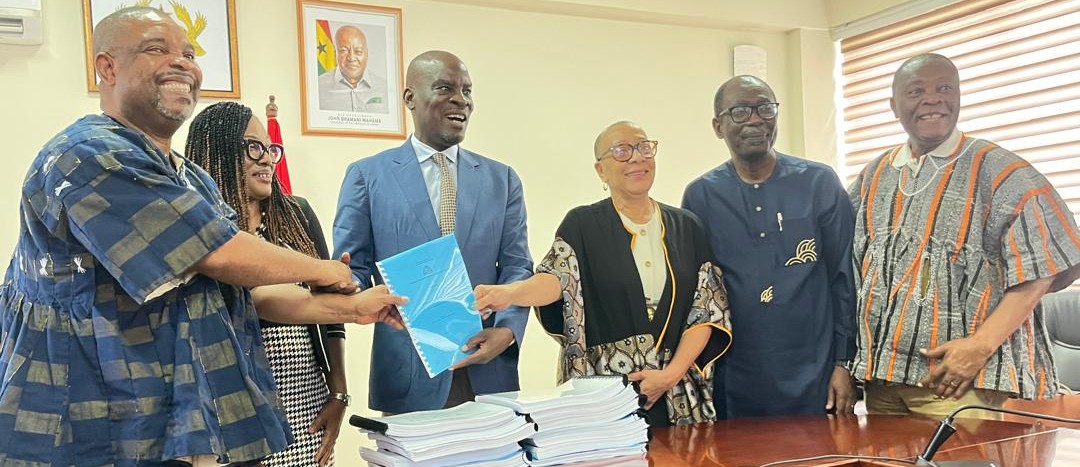
The Curriculum Review Committee has presented a revised curriculum for kindergarten to Primary Six to Mr Haruna Iddrisu, Education Minister, proposing new subjects and changes to language instruction.
The revised curriculum introduces civic education, artificial intelligence literacy, computational thinking, coding, digital citizenship, and optional Arabic and Chinese language studies.
Presenting the report to the Minister, in Accra, Professor Samuel Ofori Bekoe, Director-General of the National Council for Curriculum and Assessment (NaCCA), said the review was undertaken between March and July 2026.
He said the exercise engaged 160 writers and reviewers across 12 subject areas under the guidance of a technical working group.
Prof Bekoe said the revised curriculum retained about 80 per cent of the existing content while introducing targeted, evidence-based reforms.
He said the review was prompted by concerns over foundational literacy and numeracy outcomes, feedback from teachers on curriculum overload and fragmentation, and recommendations from external technical reviews.
Among the proposed reforms are the integration of science and agriculture to promote inquiry-based learning and the introduction of French from Basic One instead of Basic Four to strengthen early language acquisition.
The committee recommended that the Ministry approve the revised curriculum for submission to Cabinet and subsequent publication.
It also recommended a phased and adequately resourced teacher-training programme, beginning with a foundational phase, and the implementation of a monitoring and evaluation framework.
The Minister referred the revised curriculum to the Ghana Education Service (GES) for operational quality assurance.
He directed the GES to complete its review within one week to ensure the curriculum met implementation readiness and quality standards.
Mr Iddrisu also directed that a Ghanaian language would remain the medium of instruction from kindergarten to Basic Three, while English would be taught as a subject with emphasis on play-based oral activities.
He said the approach would strengthen literacy by enabling children to develop reading skills first in their mother tongue before transitioning to English.
“For emphasis and clarification, from basic four onwards, the English language will become the primary medium of teaching and learning as well as a subject.
“This creates a smooth linguistic bridge that ensures that students master their mother tongue first without sacrificing fluency in English at the upper primary, Junior High School and Senior High School/TVET education level,” he said.
Source: GNA