
By Nana Karikari, Senior Global Affairs Correspondent
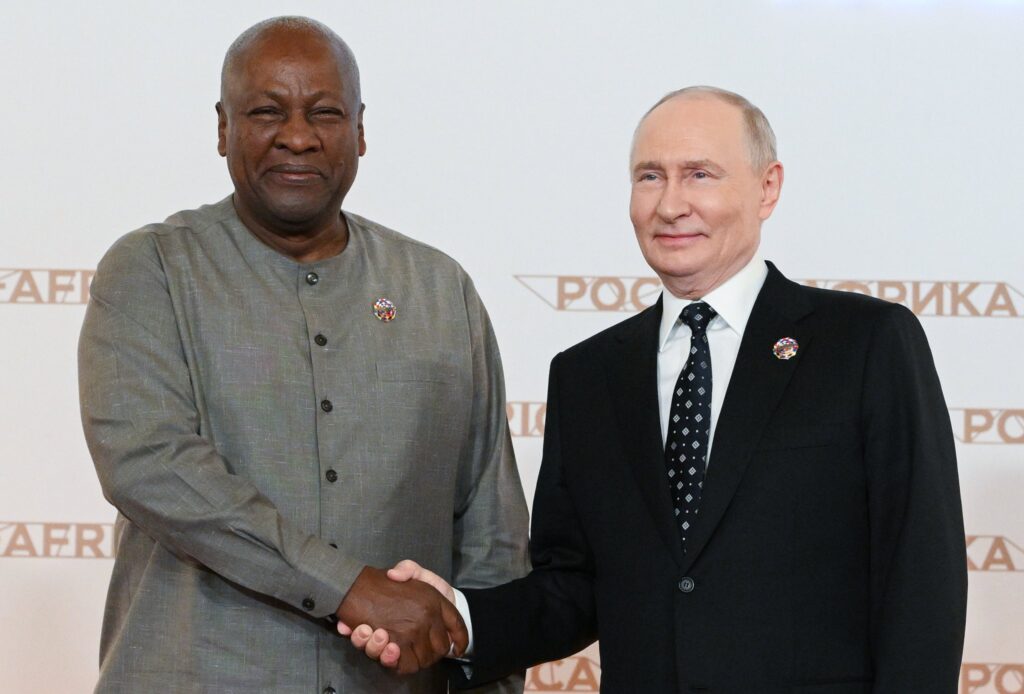
Russian President Vladimir Putin on Wednesday hosted dozens of African leaders at a Russia-Africa summit, part of Moscow’s efforts to expand its influence across the continent. Speaking at the opening of the two-day Russia-Africa summit in Moscow, Putin cast it as an “organic part of a global transformation” and an end to Western domination, noting that “we are witnessing a multipolar world becoming a reality — a trend that is both objective and irreversible.”
He framed the shift as a necessary departure from longstanding international structures. “The era when the destinies of entire continents were determined by a narrow bloc of states is coming to an irreversible end,” Putin said. “It is being replaced by a more just world, in which the voices of all nations participating in international affairs must be heard.”
Institutional and Trade Proposals
In his speech at the forum, Putin called for strengthening Africa’s role in making decisions at the International Monetary Fund and the World Bank Group to meet the continent’s needs. He pointed to global economic structures as key sites requiring reform to better serve developing nations.
Addressing critical economic ties, Putin emphasized that Russia delivers grain and fertilizers to more than 40 African countries and stands ready to expand supplies. The focus on agricultural trade highlights Moscow’s aim to position itself as a reliable security and food partner.
Expanding Geopolitical Footprint
The Russia-Africa summit marks a renewed Kremlin effort to bolster ties with a continent of nearly 1.6 billion people that is increasingly assertive on the global stage. Africa’s 54 nations make up the largest voting bloc at the United Nations.
Moscow first hosted the Russia-Africa summit in 2019, and then again in 2023. This week’s summit drew 48 African nations, about 20 of which were represented by their leaders. As Russia competes with the United States, Europe and China for greater influence across Africa, it has relied on its military contractors to strengthen its sway on many fronts, from the economy to security and politics.

Shift in the Sahel Region
Across the Sahel region, a vast arid expanse south of the Sahara Desert, militaries that grabbed power citing security failures have severed ties with longtime Western security allies and turned to Russia. They first welcomed the Moscow-backed Wagner private mercenary group before it was replaced by the Africa Corps under the direct command of the Russian Defense Ministry.
In August, Russia’s Africa Corps military contractor helped Niger’s junta quickly defeat a mutiny by a group of young troops in the country’s capital. The dynamic underscores how Moscow uses security assistance to entrench its footprint.
It’s not known how many Russian mercenaries are in the Sahel’s three junta-led countries of Niger, Mali and Burkina Faso, but varying estimates put the number between 1,700 and 2,000. In the Central African Republic, there have been around 1,000 Russian private contractors.
West African Impact and Ghana Economic Dimension
For West Africa, Moscow’s economic and agricultural proposals hold direct implications for market stability and food security. In nations like Ghana, expanded supplies of Russian fertilizer and raw materials align with national drives to boost local agricultural processing, stabilize cocoa outputs, and improve crop yields. Additionally, with Accra hosting the African Continental Free Trade Area Secretariat, Russian investors increasingly view Ghana as an entry point for broader trade, technology transfers, and energy partnerships across the continent.
Strategic Horizon and Global Realignment

The summit underscores a broader structural realignment in international relations. As African governments actively seek to diversify their trade and defense partnerships, Moscow continues to present itself as a counterweight to traditional Western influence. The ultimate success of these diplomatic and military initiatives will depend on whether Moscow can deliver sustainable economic development alongside its growing security footprint across the continent