
By Konrad Kodjo Djaisi
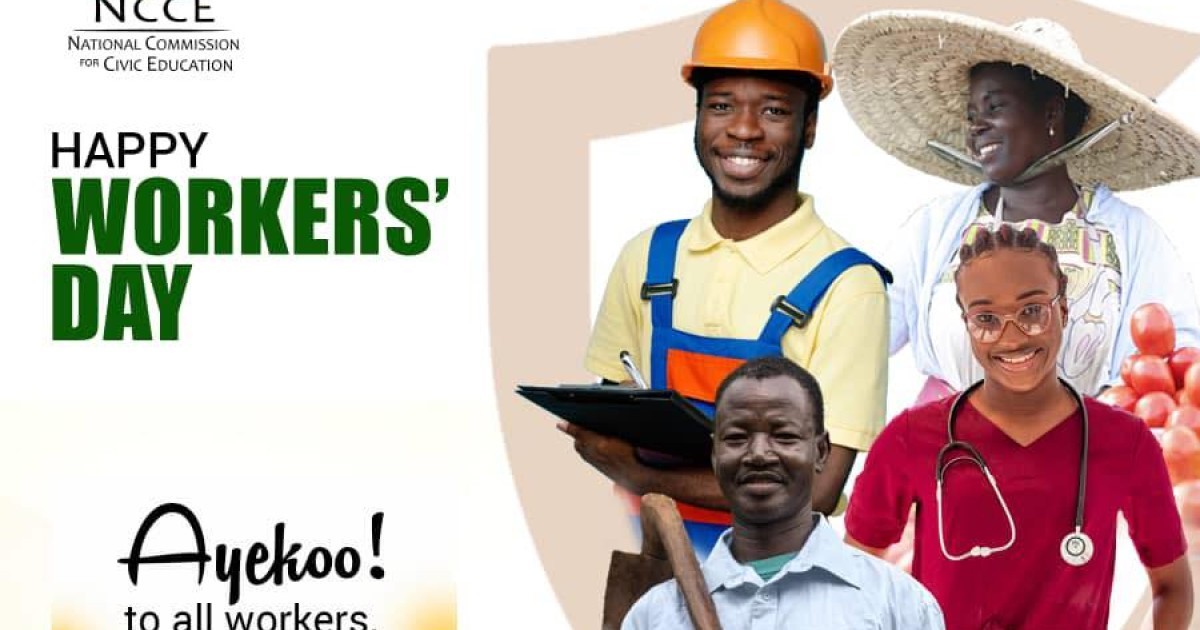
May 1st is celebrated as May Day in most countries around the world. The holiday may also be known as International Worker’s Day or May Day and is marked with a public holiday in over 80 countries. It is promoted by the international labour movement to honour workers’ rights and achievements.
Workers’ Day is a day for working people to have a rest from their usual labour.
Ghanaian workers observed their first May Day in 1960 and Ghana’s first President, Osagyefo Dr Kwame Nkrumah, was declared the “First Number One Worker” and decorated with a May Day Award by the Trades Union Congress(TUC). The TUC enjoyed a cordial relationship with the first government of Ghana, headed by Dr. Kwame Nkrumah. The TUC however suffered a setback after the overthrow of the first government in 1966.
However, the May Day celebration was suspended for a year in 1966 following the first military coup which toppled Dr. Nkrumah’s Government in February of that year. The celebration was resumed a year later in 1967.
The main event on Labour Day in Ghana is a big parade put on by the Trade Union Congress. It involves both trade unions and the military, and the event is a major spectacle that people look forward to seeing each year.
Beyond parades and public holidays, the day offers an opportunity to revisit Ghana’s labour laws, ensuring that both employers and employees understand the rights, responsibilities, and protections enshrined in our legal framework.
Generally, there are two trade union federations in Ghana: The Ghana Trade union (TUC) with a total of 18 affiliates and five (5) associate informal sector members and the Ghana Federation of Labour (GFL) with ten (10) affiliates. TUC has consistently insisted on all governments to address the inequalities in public sector pay.
TUC has been actively involved and committed to the implementation of the Single Spine salary structure (SSSS). The Single Spine Salary Structure (SSSS) is a unified pay policy introduced in Ghana in 2010 to standardize public sector wages, covering employees under Article 190 of the 1992 Constitution.
It aims to reduce pay disparities, basing salary, or “spine,” placement on job evaluations (job content, responsibilities). The structureis managed by the Fair Wages and Salaries Commission (FWSC), and uses a, sometimes controversial, base pay and pay-point relativity.
Since the introduction of the reforms, Organised Labour has been engaged in the processes to prevent encounters where unions have come on board too late to make an impact.
As at June, 2011, about 68% of public sector workers have been migrated onto the SSSS. Organised labour has raised a concern about the need for government to fast tracking the process of migrating the remaining 32% unto the Spine.
Ghana sees less political unrest around Labour Day than many other countries in Africa and around the world. There is a greater sense of unity and of working together for the common good, perhaps, than in many other places.
Whether the Ghanaian worker’s condition has improved since independence in 1957 is a complex issue with mixed results. While legal, educational, and institutional frameworks have evolved to offer better protection, the economic reality for the majority of workers—characterized by low wages, high inflation, and informal employment—has faced significant challenges and stagnation.
Since independence, the majority of the workforce (over 80%) remains in the informal sector, often with low, irregular income and lack of basic state protection, such as social security.
Despite the introduction of minimum wage policies, many workers struggle to meet basic living standards. Low pay, rather than lack of skill, remains a significant driver of poor motivation and low productivity, particularly in the public sector.
The right to organise and do collective bargaining is one of the core conventions of the United Nations International Labour Organisation (ILO). Ghana ratified the ILO convention in 1957 and has since provided a legislative and institutional framework for collective bargaining.
The main services provided by trade unions in Ghana can be put into three namely; collective bargaining, legal representation and education and research. The Labour Act (Act, 651) confers on trade unions the right to enter collective bargaining with employers. Eligible trade unions must acquire a collective bargaining certificate from the Labour Department.
The Trades Union Congress (TUC) remains the largest union federation and the mouthpiece of Organised Labour in Ghana. The trade unions have indeed made some milestones regarding work legislation and practices at workplaces, and a number of negotiations with employee’ unions specifically on agreements recognition, wages, and conditions of service, workplace restructuring and retrenchments have led to some improvements.
While joblessness has remained relatively low in terms of statistics, the quality of jobs has remained low, with many workers in low-productivity roles. The TUC (Trade Union Congress) noted that over the past 40 years of economic growth, employment has shifted to the informal sector, and “good jobs” are harder to obtain.
Public sector workers, while having better job security, have faced distortions in salary structures, leading to consistent labour agitations and industrial action for better conditions.
Workers’ conditions in Ghana since 1957 have transitioned from optimism regarding rapid industrialization to periods of economic hardship, labour struggles, and persistent structural challenges. While early post-independence years saw formal employment expansion, recent decades are marked by high unemployment (14.7% in 2026), reliance on informal labor, and low productivity.
On the positive side, significant improvements have been made in labor law, such as the Labour Act (Act 651), which provides a better framework for worker rights, unionization, and safety compared to the colonial era.
Globally, organization and governance of work is changing rapidly with the economic, demographic, technological and environmental trends. These changes have deteriorated hard won rights of workers in formal employment pushing them into temporary and self-employed work arrangements.
In summary, while workers in 2026 have better legal protection and higher formal education levels than in 1957, their overall economic well-being is heavily hindered by macroeconomic instability (high inflation and currency depreciation) and a slow shift away from low-productivity, informal labor.
Trade unions have indeed made some milestones regarding work legislation and practices at workplaces, and a number of negotiations with employee’ unions specifically on agreements recognition, wages, and conditions of service, workplace restructuring and retrenchments have led to some improvements.
Brief History of International Workers’ Day
In May 1886, 400,000 workers in many parts of the USA went on strike, demanding an eight-hour working day. The strike started peacefully, but on the third day of protests in Chicago there was some violence. The police shot at unarmed workers, killing several of them.
The next day there were more protests and someone threw a bomb. Seven police officers and four workers were killed by the bomb or police shooting just after the bomb. The person who threw the bomb was never identified, but eight workers were arrested. Seven of them were sentenced to death, and one of them was sent to prison for 15 years.
This event, known as The Haymarket Affair, was very important in bringing working people together in the USA. Many people didn’t believe the men were guilty, and the trial was criticised for being unfair. The Haymarket Affair became an international symbol of the struggle for workers’ rights, and May 1 was chosen to be International
Post Views: 7
Discover more from The Business & Financial Times
Subscribe to get the latest posts sent to your email.